Req 4 — Endurance Swim
Understanding the Endurance Swim
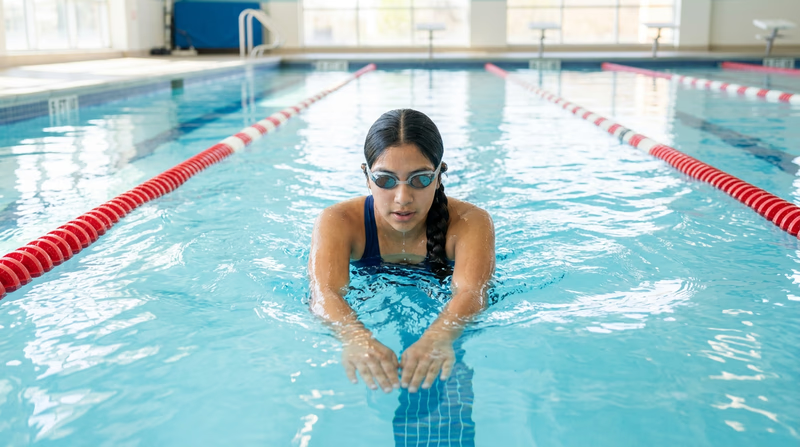
This requirement brings together everything you practiced in Requirement 3. You will swim 150 yards continuously — that is six lengths of a standard 25-yard pool — using all five strokes. The swim is not timed for speed. Your counselor is watching for continuous swimming with good form on each stroke.
Here is the breakdown:
| Stroke | Distance | Pool Lengths |
|---|---|---|
| Front crawl or trudgen | 25 yards | 1 |
| Back crawl | 25 yards | 1 |
| Sidestroke | 25 yards | 1 |
| Breaststroke | 25 yards | 1 |
| Elementary backstroke | 50 yards | 2 |
| Total | 150 yards | 6 |
The elementary backstroke gets 50 yards because it is a resting stroke — this portion serves as your cool-down and demonstrates your ability to swim efficiently over a longer distance.
Planning Your Order
There is no single “best” order, but here are two strategies:
Strategy 1: Hard to Easy
- Front crawl (25 yds) — highest energy demand first
- Back crawl (25 yds) — still face-up recovery between the two hardest strokes
- Breaststroke (25 yds) — moderate effort
- Sidestroke (25 yds) — restful and efficient
- Elementary backstroke (50 yds) — finish relaxed
Strategy 2: Alternate Effort
- Front crawl (25 yds) — hard
- Sidestroke (25 yds) — easy
- Back crawl (25 yds) — moderate
- Elementary backstroke (50 yds) — easy
- Breaststroke (25 yds) — moderate finish
Pick the order that works best for your strengths. Practice the full sequence at least once before your merit badge session.
Tips for Success
Transitions
When you switch strokes at the wall, you do not need to stop — but you can take a moment to push off and settle into the new stroke. A smooth transition shows your counselor that you are in control.
Pacing
This is not a race. Swim at a pace you can maintain for the full 150 yards. If you sprint the front crawl and arrive at the wall gasping, you will struggle through the remaining strokes. Steady and controlled wins.
Breathing
Each stroke has its own breathing pattern. During transitions, take a couple of extra breaths at the wall if needed. Controlled breathing keeps your heart rate manageable and prevents the panicky feeling of being out of air.
Form Over Speed
Your counselor is looking for “good form” on every stroke. Here is a quick refresher on what that means:
- Front crawl: Smooth arm turnover, face in the water with side breathing, steady flutter kick
- Back crawl: Body flat, hips up, alternating arm windmill, flutter kick
- Sidestroke: On your side, coordinated arm pull and scissor kick with a visible glide
- Breaststroke: Symmetrical arm sweep and whip kick with a glide phase
- Elementary backstroke: Simultaneous arm-and-kick motion with a long, relaxed glide
If you need a refresher on any stroke, review Req 3 — Swimming Strokes.
Endurance Swim Preparation
Get ready for your 150-yard swim
- Practice each stroke individually for at least 50 yards: Build comfort with every stroke.
- Swim the full 150 yards continuously at least once: Know you can do it before test day.
- Choose your stroke order and practice it: Eliminate surprises.
- Practice wall transitions: Push off smoothly and settle into the new stroke quickly.
- Focus on pacing: Swim at 70-80% effort, not 100%.