Req 5a — Rescue Methods
The Order of Rescue: Reach, Throw, Row, Go
Water rescue follows a clear priority order, from safest to most dangerous. You should always start with the safest option and only move to riskier methods if simpler ones are not possible.
- Reach — Extend something to the victim from a safe position
- Throw — Toss a flotation device or line to the victim
- Row — Use a boat or watercraft to reach the victim
- Go — Swim to the victim (last resort, trained rescuers only)
For this requirement, you will demonstrate the first two methods: reaching and throwing.
Reaching Rescues
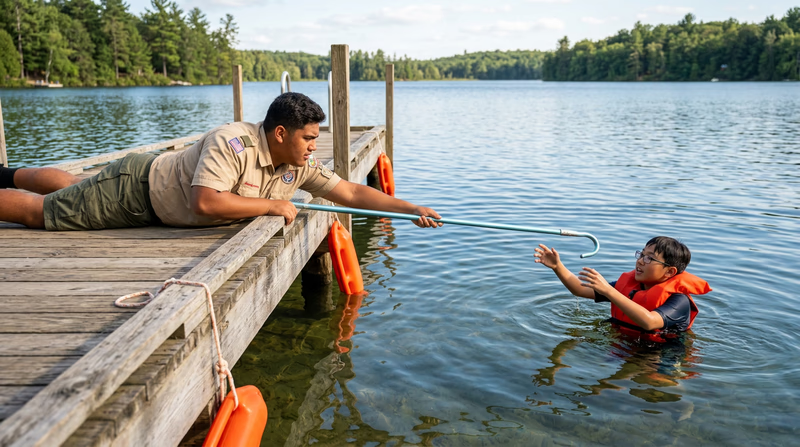
A reaching rescue means extending something to the victim while you stay on solid ground or in shallow water. This is the safest and fastest type of rescue.
Reaching with Your Arm or Leg
If the victim is close to the edge of a pool, dock, or shoreline:
- Lie flat on your stomach at the edge to lower your center of gravity and avoid being pulled in.
- Extend your arm toward the victim and tell them to grab your wrist (not your hand — wrist grips are harder to break).
- If they are slightly farther away, sit on the edge, brace yourself, and extend your leg for them to grab.
- Pull them to safety once they have a firm grip.
Reaching with an Object
If the victim is too far for an arm or leg reach, extend an object:
- Pool noodle, kickboard, or towel — hold one end and extend the other
- Branch, pole, or paddle — anything long and sturdy
- Shepherd’s crook (the hooked rescue pole found at most pools)
The key is to brace yourself so you do not get pulled in. Lie flat, hook your feet on something solid, or have someone hold your legs.
Throwing Rescues
When the victim is too far to reach, throw something that floats to them.
What to Throw
- Ring buoy (the red-and-white rings mounted near pools and docks)
- Throw bag (a bag filled with coiled rope — common at waterfront areas)
- Any flotation device: life jacket, cooler, empty water jug, sealed plastic container
- A rope or line with something tied to the end for weight
How to Throw
- Get the victim’s attention. Shout “Grab this!” before you throw.
- Aim past the victim slightly — it is easier for them to pull a line toward them than to swim to it.
- Throw underhand for accuracy with ring buoys and throw bags.
- If you miss, quickly re-coil and throw again. Do not wade in.
- Once they grab it, pull them to safety or tell them to kick toward shore while holding on.
Why Not Just Swim Out?
Your counselor will ask you to explain why swimming rescues should be avoided when reaching or throwing is possible. Here is why:
A Drowning Person Is Dangerous
A person who is drowning is in survival mode. They are not thinking clearly. Their instinct is to grab anything — including you — and push it down to get their head above water. A panicking victim can easily overpower a rescuer, dragging both of them under.
It Takes Training
Swimming rescues require specialized training in approach techniques, defensive positions, and escape methods. Even strong swimmers can be overwhelmed by a panicking victim without this training. The Lifesaving merit badge covers these advanced rescue swimming skills.
It Is Slower and Riskier
Swimming to a victim takes time, burns energy, and puts you in the water — where you are vulnerable. A reaching rescue takes seconds. A throwing rescue can cover 50+ feet almost instantly. Both keep you safe on shore.
How Rescue Swimmers Avoid Contact
If a swimming rescue is the only option (and it should truly be the last resort), trained rescue swimmers use these techniques to avoid dangerous contact:
- Approach from behind. A victim facing away from you cannot grab you.
- Bring a flotation device. Push it toward the victim so they grab it instead of you.
- Talk to them. “Turn over! Grab this! I am here to help!” A victim who is responsive is less dangerous.
- Maintain distance. Stay at arm’s length and extend a rescue device between you and the victim.
- If grabbed, trained rescuers know escape techniques — submerging, twisting, and pushing away. These are taught in lifeguard and Lifesaving merit badge training.