Textile Merit Badge — Complete Digital Resource Guide
https://merit-badge.university/merit-badges/textile/guide/
Introduction & Overview
Overview
You are surrounded by textiles from the minute you wake up. Your sheets, socks, backpack straps, hoodie, tent rainfly, seat belt, and even some sports gear all depend on fibers turned into useful fabric. The Textile merit badge helps you look past the finished product and understand how those materials are made, why they behave differently, and how people use them in everyday life.
Textiles matter because they solve real problems. Some fabrics keep you warm, some stretch so you can move, some wick sweat away from your skin, and some help protect firefighters, climbers, or astronauts in dangerous conditions. Once you understand fibers, yarns, construction, and finishing, you start noticing why one fabric works better than another.
Then and Now
Then
Textiles are one of humanity’s oldest technologies. Long before factories existed, people twisted plant fibers into cordage, spun animal hair into yarn, and wove cloth on simple looms. Linen from flax, wool from sheep, and silk from silkworms helped shape trade routes, local economies, and even national power. For thousands of years, making cloth took patience and skilled handwork.
Later, spinning wheels, water-powered mills, and mechanized looms changed everything. Fabric that once took days or weeks to produce could now be made much faster. That shift helped fuel the Industrial Revolution and changed what people wore, how goods were traded, and where people worked.
Now
Today, textiles include far more than clothing. Engineers design fabrics for airbags, sails, medical products, outdoor gear, carpeting, geotextiles that stabilize soil, and protective equipment that resists heat or abrasion. Modern mills use computer-controlled machines, but the same core ideas still matter: choose the right fiber, turn it into yarn, build a fabric structure, and finish it for the job it must do.
Textiles also sit at the center of important modern questions. How durable is a garment? How much water or energy did it take to make? Can it be repaired, reused, or recycled? Studying textiles gives you a better eye for quality, waste, and smart design.
Get Ready!
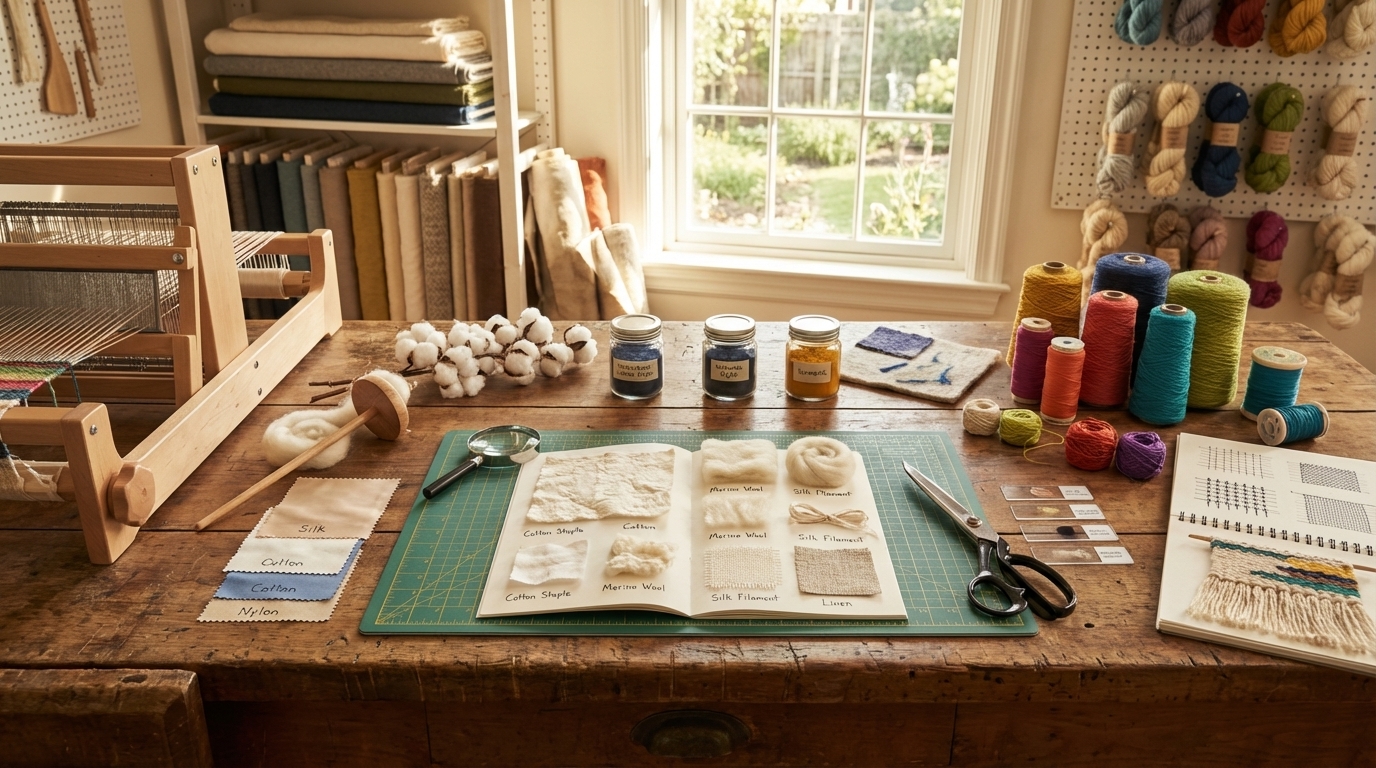
This badge is hands-on. You will collect swatches, compare fibers, look closely at fabric structure, and choose projects that let you make or test textiles yourself. Come ready to touch materials, ask good questions, and explain not just what a fabric is called, but why it acts the way it does.
Kinds of Textiles
Natural Fiber Textiles
These begin with materials that come from plants or animals, such as cotton, flax, wool, and silk. They often feel familiar because they have been used for centuries, but each one behaves differently. Cotton is breathable, wool insulates even when damp, linen is crisp and strong, and silk is smooth and fine.
Manufactured Fiber Textiles
Some fibers start with cellulose from plants, while others are made from chemicals derived from petroleum or natural gas. Rayon, acetate, and lyocell are cellulosic manufactured fibers. Polyester, nylon, acrylic, olefin, and spandex are synthetic manufactured fibers. These materials can be engineered for stretch, wrinkle resistance, weather resistance, or strength.
Woven, Knitted, and Nonwoven Textiles
A fiber alone is not yet fabric. Woven fabrics interlace warp and weft yarns, knitted fabrics form loops, and nonwoven fabrics mat, bond, or fuse fibers together. That construction changes how a textile drapes, stretches, breathes, and wears out.
Performance and Specialty Textiles
Some textiles are built for very specific jobs. Think of felt for padding and craft work, waterproof outdoor shells, firefighter turnout gear, racing suits made with aramid fibers, and carbon-fiber-based materials used in aerospace and sports equipment. In textiles, the right material choice can be the difference between comfort and failure.
Ready to start with the basics? The first requirement helps you explain what textiles are, why they matter, and how they show up in your daily life.
Req 1 — Why Textiles Matter
If all the fabric disappeared from your day, you would notice fast. No T-shirts, towels, sleeping bags, bandannas, shoelaces, backpack straps, flags, curtains, or car upholstery. Textiles are easy to ignore because they are everywhere, but that is exactly why they are important.
Why Textiles Matter
Textiles do more than cover your body. They provide warmth, protection, comfort, visibility, and strength. A cotton T-shirt helps your skin breathe. A fleece jacket traps warm air. A nylon tent floor resists abrasion. A seat belt webbing is designed to handle tremendous force in a crash. Even when two items look similar, the textile choice may be completely different because each item has a different job.
Textiles also matter economically and historically. Entire regions grew around cotton mills, wool production, silk weaving, and later synthetic fiber plants. Today the textile world includes farming, chemistry, engineering, design, manufacturing, quality testing, logistics, retail, repair, and recycling.
Fiber, Fabric, and Textile
These three words are related, but they are not the same.
- Fiber is the smallest starting material: a fine, threadlike strand. Cotton, wool, silk, polyester, and nylon all begin as fibers.
- Fabric is cloth made by weaving, knitting, or bonding fibers or yarns together.
- Textile is the broadest word. It can mean a fiber, filament, yarn, fabric, or something made from them.
A simple way to remember it is this: fiber is the ingredient, fabric is the cloth, and textile is the whole category.
Everyday Examples You Can Use With Your Counselor
When you discuss this requirement, do not stop at naming items. Go one step further and explain why the textile fits the job.
Textiles You Probably Used Today
Notice the job each material is doing- Clothing: Your shirt, socks, jeans, sweatshirt, or athletic uniform may need softness, stretch, warmth, or durability.
- Sleep items: Sheets, blankets, pillowcases, and mattress covers are chosen for comfort, warmth, and easy cleaning.
- Outdoor gear: Tents, sleeping bags, rain jackets, and backpacks often use tightly woven or coated fabrics for weather resistance and strength.
- Home items: Towels, curtains, carpets, furniture covers, and kitchen cloths all use different constructions for absorbency, insulation, or wear resistance.
- Transportation and safety: Seat belts, airbags, and some helmets use highly engineered textile parts.
How to Sound Strong in the Discussion
Your counselor is likely listening for clear explanations, not fancy vocabulary. A good answer uses examples and comparison.
For example, instead of saying “textiles are important because we use them,” you could say: Textiles matter because they solve different problems. Cotton is comfortable and breathable for everyday wear, wool insulates well, and nylon is strong enough for gear like backpacks and tents.
Official Resources
🎬 Video: Textiles: What Are They? Where Do They Come From? (video) — https://youtu.be/7-fLaXF6kOs?si=VNaU9JCXzi2FZEq7
Use this video as a quick overview before your counselor conversation. As you watch, listen for examples of natural and manufactured fibers, then look around your own home for matching examples.
Now that you know the basic language, the next step is to compare real samples and follow the path from raw fiber to finished fabric.
Req 2 — From Fiber to Fabric
This requirement gives you the foundation for the rest of the badge. You will gather real samples, compare what they are made from, trace how fibers become yarn and fabric, and then use that knowledge to make a smart buying choice. If Req 1 taught you why textiles matter, Req 2 shows you how textile thinking actually works.
Requirement 2a: Build a Swatch Set
A swatch is a small sample that lets you compare materials side by side. This part works best when you can touch, bend, wrinkle, stretch, and closely inspect each sample. Ask at a fabric store, sewing space, upholstery shop, thrift store, or at home from damaged or scrap items.
What to Look For in Each Swatch
As you collect your five samples, notice:
- how the surface feels: smooth, fuzzy, slick, crisp, stretchy, or bulky
- how it reacts when you crumple it: does it spring back or stay wrinkled?
- how heavy it feels for its thickness
- whether the fabric seems woven, knitted, or nonwoven
- whether it looks matte or shiny
A Balanced Swatch Set
Choose samples that are easy to compare- Natural sample 1: Cotton or linen work well because they are common and easy to recognize.
- Natural sample 2: Add a contrasting sample such as wool or silk so the feel is clearly different.
- Synthetic sample 1: Polyester is easy to find in athletic wear, fleece, and home textiles.
- Synthetic sample 2: Nylon, acrylic, olefin, or spandex can show strength, loft, or stretch.
- Cellulosic sample: Rayon, acetate, or lyocell often drape softly and may feel different from both cotton and polyester.
Requirement 2b: Explain the Fibers
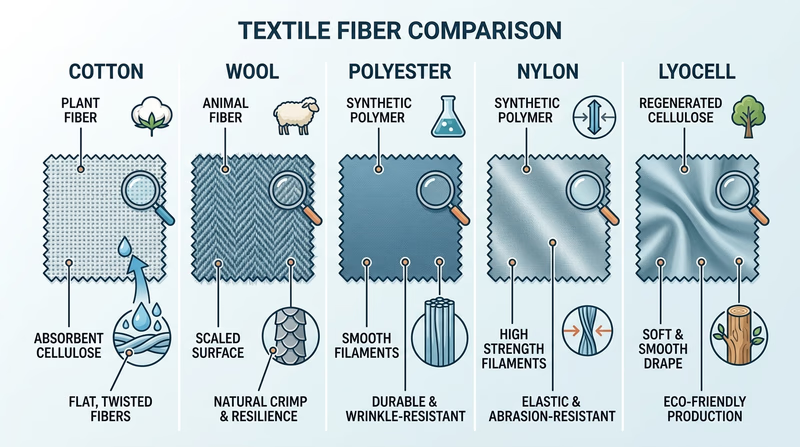
This is where your swatch set becomes evidence. Your counselor wants to hear where each fiber comes from, how it usually behaves, and what makes one category different from another.
Natural Fibers
Natural fibers come from plants or animals.
- Cotton comes from the seed hairs of the cotton plant. It is breathable, absorbent, and comfortable, but it can wrinkle and may dry slowly.
- Linen comes from flax. It is strong, cool in warm weather, and crisp, but it wrinkles easily.
- Wool comes from animal fleece, usually sheep. It insulates well, can stay warm when damp, and often springs back well, but some wool can feel scratchy.
- Silk comes from silkworm cocoons. It is smooth, fine, and strong for its weight.
Cellulosic Manufactured Fibers
Cellulosic manufactured fibers begin with cellulose, the natural material found in plant cell walls. The source is still plant-based, but people dissolve or chemically process that cellulose and form it into new fibers.
- Rayon usually drapes softly and absorbs moisture well.
- Acetate often has a smooth, silky look and is used in linings or dress fabrics.
- Lyocell is also cellulose-based and is known for softness, good drape, and improved strength.
Synthetic Manufactured Fibers
Synthetic fibers are made from chemicals, usually derived from petroleum or natural gas.
- Polyester is durable, quick-drying, and wrinkle resistant.
- Nylon is strong and abrasion resistant.
- Acrylic feels wool-like and holds color well.
- Olefin is lightweight and resists moisture.
- Spandex stretches dramatically and then recovers.
The Big Difference
A cellulosic manufactured fiber starts with plant-based cellulose and is processed into fiber form. A synthetic manufactured fiber starts with man-made chemicals and is built into fiber form from those chemicals.
🎬 Video: Natural vs Synthetic Fibers (Which to Choose and Why) (video) — https://youtu.be/cRLPUAPCfuo
Watch for the tradeoffs in the video, not just the labels. No fiber is automatically “best.” The better question is: best for what job?
Requirement 2c: From Raw Fiber to Yarn to Fabric
This process changes loose material into something useful and durable.
Step 1: Prepare the Fiber
Raw fibers usually need cleaning and organizing first. Cotton must be separated from seeds and cleaned. Wool is scoured to remove dirt and grease. Flax must be retted and processed to free the fibers. Manufactured fibers start as a liquid pushed through a spinneret, which works like a nozzle with tiny holes.
Step 2: Align the Fibers
Before spinning, many fibers are carded or combed so they point in roughly the same direction. Carding opens and straightens the mass. Combing goes farther by removing shorter fibers and producing a cleaner, more even result.
Step 3: Spin the Yarn
Spinning draws out fibers, twists them together, and winds them into a continuous strand. Twist adds strength. Without enough twist, the fibers pull apart too easily.
Step 4: Turn Yarn into Fabric
Yarn can become fabric in several ways:
- Weaving interlaces lengthwise warp yarns with crosswise weft or filling yarns.
- Knitting forms loops that interlock with other loops.
- Bonding or felting joins fibers without weaving or knitting.
Step 5: Finish the Fabric
Fresh fabric is often unfinished. It may be dyed, softened, preshrunk, waterproofed, brushed, flame resistant, or given other treatments depending on its purpose.
🎬 Video: From Cotton to Yarn (video) — https://youtu.be/vFaNiTlHeCY
🎬 Video: Weaving Process (video) — https://youtu.be/NIt9SGk55b4
🎬 Video: Knitting Process (video) — https://youtu.be/yRXuKFy89Mg
🎬 Video: Complete Process of Textile Manufacturing Fiber to Complete Garments (video) — https://youtu.be/5nUjGNDImIk
Requirement 2d: Choose a Smart Purchase
A smart answer starts with the item and the job it must do. A winter hat, soccer jersey, bath towel, dress shirt, and backpack do not need the same fiber properties.
Match the Fiber to the Job
If you were buying a hiking base layer, you might want a polyester or wool blend because it handles moisture better than cotton. If you were buying bedsheets for hot weather, you might choose cotton or linen for breathability. If you wanted leggings or athletic gear, you might look for spandex blended with another fiber to add stretch and recovery.
A strong answer might sound like this: If I were buying a backpack, I would want a strong synthetic fiber such as nylon or polyester because it needs abrasion resistance, weather resistance, and durability. I would not choose a delicate fiber like silk because the job is completely different.
You have now worked from sample collection to material choice. Next you get to pick two hands-on projects that let you explore textile work more directly.
Req 3 — Pick Your Two Projects
You must choose exactly two options for this requirement. Think of this page as your project-planning station: one option might help you learn by visiting and observing, while the other might let you learn by making, testing, or demonstrating something with your own hands.
Your Options
- Req 3a — Behind the Scenes of Textile Production: Visit a plant, manufacturer, school, or college program and report on what you learned. This option builds observation skills and helps you see the textile industry as a real workplace.
- Req 3b — Weave on a Homemade Loom: Build a simple loom and weave a useful or decorative item. This option teaches structure, tension, and patience.
- Req 3c — Compare Fabric Structures: Inspect woven, knitted, and nonwoven materials with magnification and sketch what you see. This option sharpens your eye for construction.
- Req 3d — Make Felt by Hand: Turn loose fibers into felt. This option shows how fabric can be made without weaving or knitting.
- Req 3e — Dye Fabric with Natural Color: Make two natural dyes and color fabric or a garment. This option connects textiles to chemistry, plants, and finishing.
- Req 3f — Make Fabric Resist Water: Test ways to make a fabric repel or resist water. This option focuses on finishing and performance.
- Req 3g — Identify Fibers: Demonstrate fiber identification using a microscope or breaking test. This option is a strong fit if you enjoy close observation and comparison.
How to Choose
Choosing Your Two Options
Pick a combination that gives you variety- Time available: A visit may depend on scheduling, while felt, weaving, or fabric testing can often be done at home.
- Tools and materials: Weaving needs a loom and yarn. Magnified fabric study needs a magnifying glass. Natural dyeing may need pots, plants, and a protected workspace.
- Mess level: Dyeing and felting can be wet and messy. Fabric comparison and a site visit are cleaner choices.
- What you will gain: Weaving and felting teach how textiles are made. Fiber identification and fabric comparison build analysis skills. Waterproofing and dyeing show how finishes change performance and appearance.
- Best pairings: A making project plus an analysis project usually gives you the strongest overall understanding.
| Option | Best for Scouts who like… | Main challenge | What you gain |
|---|---|---|---|
| 3a | visiting places and asking questions | arranging the visit | a real-world view of the industry |
| 3b | building and crafting | keeping even tension | understanding warp, weft, and weave |
| 3c | close observation | careful sketching | seeing how structure changes performance |
| 3d | hands-on making | controlling moisture and agitation | understanding nonwoven construction |
| 3e | color and experimentation | working neatly and safely | seeing how finishing changes fabric |
| 3f | testing and outdoor gear | judging what counts as effective | understanding water resistance vs waterproofing |
| 3g | science-style comparison | interpreting what you observe | linking fiber behavior to identification |
If you are unsure where to start, begin with the visit option on the next page. Even if you do not choose it in the end, reading it can help you think like someone working in the textile world.
Req 3a — Behind the Scenes of Textile Production
A textile visit turns this badge from theory into reality. You stop thinking only about cloth on a shelf and start seeing machines, people, testing labs, design spaces, and quality checks that all work together before a finished product reaches a store.
Good Places to Visit
You do not have to find a giant mill. A small upholstery shop, screen-printing company, quilt shop with long-arm machines, fiber arts studio, fashion program, college textile lab, costume department, or manufacturer that cuts and sews products can all teach you something useful.
What to Watch For
During the visit, try to follow the path of the material.
Questions to Guide Your Visit
Use these to build a stronger report- What fibers or fabrics does this place use most often?
- How do they decide which material fits a job best?
- What machines or hand tools are essential here?
- How do they test quality, durability, fit, color, or safety?
- What jobs do people do here besides sewing or weaving?
- What waste is created, and how is it handled or reduced?
What Makes a Strong Report
Your report should do more than say, “I went there and it was interesting.” Explain what happened in order and point out what surprised you.
A clear report usually includes:
- Where you went and what the place does
- What materials you saw being used
- What equipment or processes stood out
- What you learned about textile careers, quality, or production
- One or two details that changed how you think about textiles
Even if you choose a visit for only one of your two options, it will make the rest of the badge easier because you will have real examples in mind. The next option shifts from observing professionals to weaving something yourself.
Req 3b — Weave on a Homemade Loom
Weaving looks simple until you try to keep every strand in order. That is what makes this option so valuable. Once you build a loom and weave your own project, terms like warp, weft, shed, and tension stop being vocabulary words and become something you can feel in your hands.
Choose a Project That Fits Your Patience Level
A short headband or belt is usually easier than a large wall hanging or place mat. Your first goal is not perfection. It is to produce a clear, honest piece of weaving that shows you understand the structure.
Build a Simple Loom
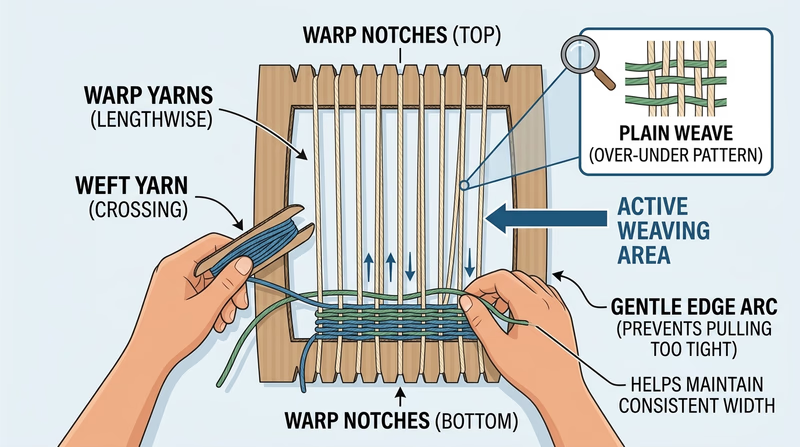
A cardboard loom is a great choice because it is cheap, easy to cut, and good for beginners. Whatever loom you make, it must hold the warp yarns under steady tension.
Basic Setup
- Cut notches evenly along the top and bottom edges.
- Wrap warp yarns from notch to notch so they run lengthwise.
- Choose a weft yarn that will pass over and under the warp.
- Use a shuttle, needle, or your fingers to weave each row.
- Push each row gently into place without packing too hard.
What to Focus On While You Weave
Even Tension
If some warp yarns are tight and others are loose, your project may bow inward or become uneven. Check the loom often while you work.
Consistent Edges
Beginners often pull the weft too tightly at the edges, which narrows the project. Let the yarn curve slightly before you press it into place.
Pattern Awareness
Even a plain weave teaches a lot. Over one, under one, repeated row after row, builds stable fabric. If you want to add stripes or color changes, do that only after the structure is working.
How to Explain the Result to Your Counselor
When you show your woven piece, be ready to discuss:
- what you used for the loom
- what yarn or strips you chose and why
- what type of item you made
- what problems you ran into
- what you learned about weaving structure
A belt or headband that looks slightly uneven is still a success if you can explain how it was made and what you would improve next time.
Weaving teaches how yarn becomes fabric. The next option helps you compare textile structures even more closely by looking at fabrics under magnification.
Req 3c — Compare Fabric Structures
This option trains your eyes. From a few feet away, many fabrics just look like fabric. Under magnification, though, their structure becomes obvious, and that structure explains why one material stretches, another frays, and another feels more like a sheet of pressed fibers than cloth.
Pick Good Samples
Use samples that clearly represent each construction.
- Woven: a cotton shirt, denim scrap, or canvas
- Knitted: a T-shirt jersey, sweater knit, or athletic knit
- Nonwoven: felt, interfacing, some wipes, or some reusable shopping bag material
What to Look For
Woven Fabric
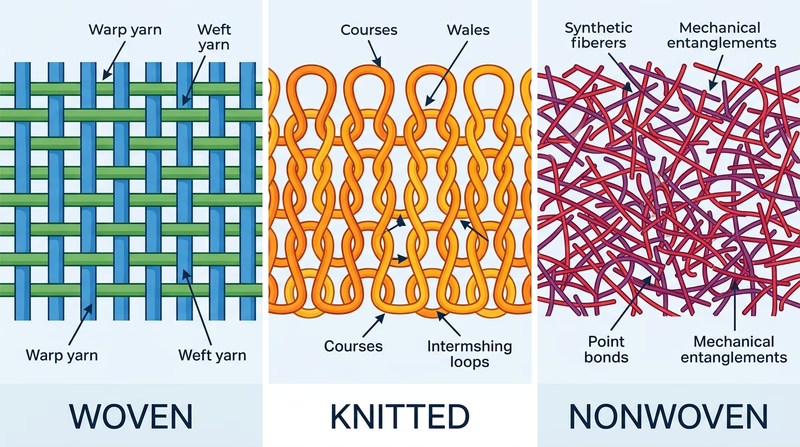
A woven fabric has two sets of yarns crossing at right angles. Under magnification, it often looks like an organized grid or basket. If you tease out a thread at the edge, you can often see the separate warp and weft directions.
Knitted Fabric
A knitted fabric is built from interlocking loops. Under magnification, those loops become the big clue. Knit fabrics usually stretch more than woven fabrics because the loop structure can open and move.
Nonwoven Fabric
A nonwoven fabric does not show an orderly over-under grid or loop pattern. Instead, you see fibers pressed, fused, tangled, or bonded together. Felt is a classic example.
🎬 Video: Woven vs. Knit vs. Non-Woven Fabrics | Textile Talk w/ A Thrifty Notion (video) — https://youtu.be/2Q_04oCLZVs
Use the video to preview what each structure looks like before you inspect your own samples.
How to Sketch What You See
Your sketch does not need to be artistic. It needs to be useful.
What to Include in Your Sketches
Make your observations easy to explain- Show the overall pattern, such as grid, loops, or random matting.
- Add arrows if you can identify directions like warp and weft.
- Label the sample as woven, knitted, or nonwoven.
- Write one or two notes about what the structure suggests, such as stretch, fraying, thickness, or softness.
How the Constructions Differ
A good explanation connects structure to behavior.
- Woven fabrics are often stable and strong, but some can fray at cut edges.
- Knitted fabrics usually stretch and drape well because loops can move.
- Nonwoven fabrics may resist fraying differently and are often used for special purposes such as filters, felt, padding, or disposable products.
Once you have compared structures, the next option lets you make a nonwoven fabric yourself by turning loose fibers into felt.
Req 3d — Make Felt by Hand
Felt is a great reminder that fabric does not always need to be woven or knitted. Instead of building cloth from yarn, you can mat and lock loose fibers together. That makes felt one of the simplest ways to experience textile construction directly.
What Felt Is
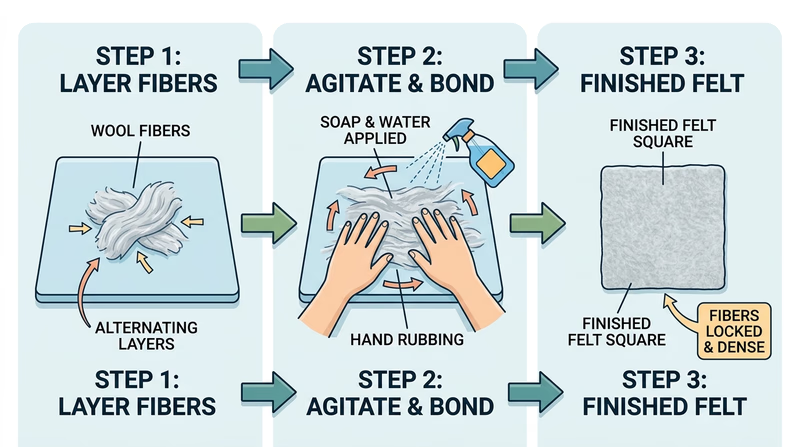
Felt is a nonwoven fabric. It forms when fibers become tangled and bonded into a dense layer. Wool is especially good for wet felting because the tiny scales on wool fibers help them lock together when moisture, soap, friction, and pressure are added.
A Simple Wet-Felting Process
- Lay thin layers of loose fiber in alternating directions.
- Wet the fibers with warm water and a little soap.
- Press gently so the fibers begin to hold together.
- Rub, roll, or agitate the piece so the fibers tighten and mat.
- Rinse and dry the finished felt.
🎬 Video: Wet Felting Tutorial for Beginners (video) — https://youtu.be/3IxCDkh-evs
This video is useful because it shows the change from loose fiber to solid fabric step by step.
What a Good Felt Sample Shows
Your felt does not need to be large. It does need to show that the fibers truly bonded.
A strong sample will:
- stay together when handled
- feel denser than the starting fiber
- show that the surface changed from fluffy to fabric-like
- keep its shape once dry
What to Tell Your Counselor
Explain the difference between loose fiber and finished felt. Describe what materials you used, what process worked best, and how the texture changed as the fibers locked together.
Felting shows one way to build fabric without yarn. The next option explores something different: how color can be added to fabric using natural dyes.
Req 3e — Dye Fabric with Natural Color
Dyeing lets you see fabric finishing in action. The color of a textile is not just decoration. It affects how a finished item looks, feels, and sometimes even how you care for it. Natural dyeing is especially interesting because the color often comes from plants, food scraps, bark, or other materials that release pigment into water.
Choose Dye Sources That Are Easy to Work With
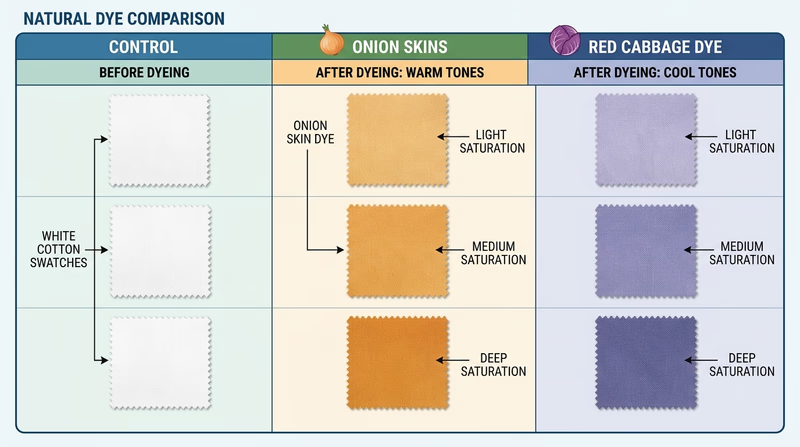
Common natural dye sources include onion skins, red cabbage, turmeric, black beans, tea, avocado pits, and some berries or flowers. Different sources can produce very different shades depending on the fabric, the water, and whether a mordant or fixative is used.
Start With the Right Fabric
Natural fibers such as cotton, linen, silk, or wool usually accept natural dyes better than many synthetics. If you dye a polyester-rich fabric, the result may be weak or uneven.
🎬 Video: Natural Dyes From Plants and Vegetables | DIY Eco-Friendly Dyes | Homeschool with Everyday Food (video) — https://youtu.be/jHpPuvibjZ8
Use this resource for ideas about easy dye sources and basic process setup.
🎬 Video: Short Tie Dye Demo - No Narration (video) — https://www.youtube.com/shorts/J6Ib3Ehy_pw?feature=share
🎬 Video: Short Tie Dye Demo - With Narration (video) — https://www.youtube.com/shorts/Oeth97r7VCw?feature=share
These short videos can help if you want a resist pattern rather than a single solid color.
A Basic Dye Process
Natural Dye Workflow
Keep your process simple and consistent- Prepare the fabric: Wash it first so dirt or finishes do not block the dye.
- Make the dye bath: Simmer your plant or food material in water to release color.
- Strain if needed: Remove solids if you want a smoother dye bath.
- Dye the fabric: Soak the fabric and keep notes on time and temperature.
- Rinse and dry: Expect the final color to look a little different once dry.
Compare Your Two Dyes
This requirement is stronger if the two natural dyes are clearly different. You might compare warm versus cool color, stronger versus weaker uptake, or one dye source that works better on one fabric than another.
What to Report
When you talk to your counselor, explain:
- what two dye sources you used
- what fabric or garment you dyed
- what steps produced the best result
- what changed once the fabric dried
- whether the color was even, mottled, light, or intense
Dyeing changes color. The next option changes performance by helping fabric resist water.
Req 3f — Make Fabric Resist Water
Outdoor gear works only if the fabric helps keep water where it belongs. This project helps you think about finishing, not just fiber content. A fabric may start out absorbent, but a finish or coating can change how water behaves on the surface.
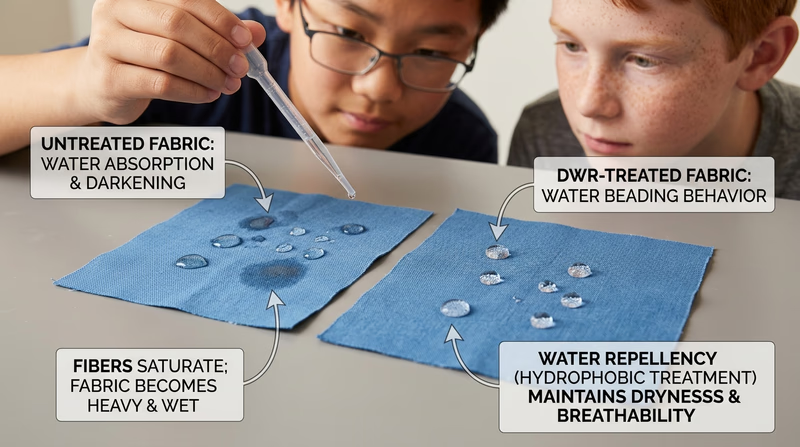
Waterproof vs. Water-Resistant
These terms are close, but not identical.
- Water-resistant fabric slows water down or sheds light moisture.
- Waterproof fabric blocks water from passing through much more completely, often by closing pores or using coatings, membranes, or sealed seams.
For this requirement, be ready to explain what method you used and how well it worked.
🎬 Video: A Simple DIY Way to Waterproof Anything (video) — https://youtu.be/y83uXupu5tY
🎬 Video: DIY Seam Seal (video) — https://youtu.be/UlHfbltn6hI
These resources are useful because they show that seams and stitch holes can matter just as much as the fabric itself.
Ways You Might Approach the Project
You might use a commercial waterproofing spray or treatment, wax a fabric such as canvas, or seal seams on a textile item. Whatever you choose, test the result instead of assuming it worked.
How to Test Your Result
Simple Waterproofing Test
Show that your project changed the fabric's performance- Start with a dry sample and observe how untreated fabric behaves with a few drops of water.
- Apply your waterproofing method according to directions.
- Let the sample cure or dry fully.
- Add water again and compare beading, absorption, and leakage.
- Record what improved and what did not.
What to Explain to Your Counselor
A strong explanation includes:
- what fabric you treated
- what waterproofing method you used
- whether you treated only the fabric or also the seams
- how you tested the result
- whether the fabric became stiffer, darker, less breathable, or more effective
Waterproofing is about how a textile performs after finishing. The next option focuses on identifying what a fiber actually is.
Req 3g — Identify Fibers
This option asks you to act like a textile investigator. Instead of trusting a label, you look for physical evidence in the fiber itself. That skill matters because fibers that seem similar on the surface can behave very differently in use.
Two Ways to Identify Fibers
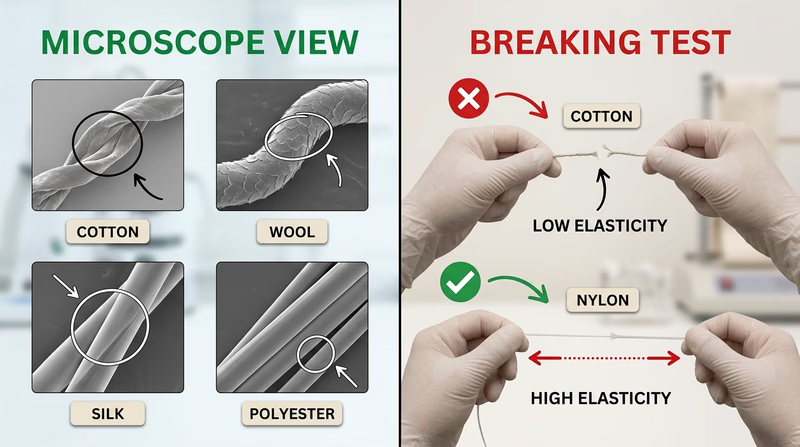
Microscope Identification
Under magnification, some fibers have distinctive shapes or surface features. Cotton often looks different from wool, and manufactured fibers may appear smoother or more uniform. This method is about careful observation.
🎬 Video: Identification of Basic Textile Fibers by Polarized Light Microscopy (video) — https://youtu.be/BbeZvRi3eUI
If you use a microscope, focus on what you can clearly describe, not on pretending certainty you do not have. Your counselor will care more about honest observation than about sounding like a lab report.
Breaking Test
A breaking test compares how fibers react when pulled. Some stretch more before breaking. Some snap quickly. Some feel stronger, smoother, or more resilient. The point is to compare behavior, not just guess.
What to Observe
Fiber Clues
Notice behavior, not just appearance- Surface: smooth, fuzzy, scaly, twisted, or uniform
- Strength: easy to break or surprisingly strong
- Stretch: little stretch, moderate stretch, or high stretch
- Recovery: springs back or stays deformed
- Feel: slick, dry, soft, crisp, or springy
Build a Careful Demonstration
Use known samples if possible, such as cotton thread, wool yarn, polyester thread, or nylon cord. Compare at least a couple of clearly different fibers so your observations are meaningful.
After these project choices, the guide turns back to a full requirement page focused on textile terms you will hear throughout the field.
Req 4 — Talk Like a Textile Maker
You only need to explain 10 terms, but learning more than 10 will make the rest of the badge much easier. These words describe the materials, tools, and processes that textile makers use all the time. If you can connect each term to a clear image or example, you will remember it much better.
Terms Connected to Weaving
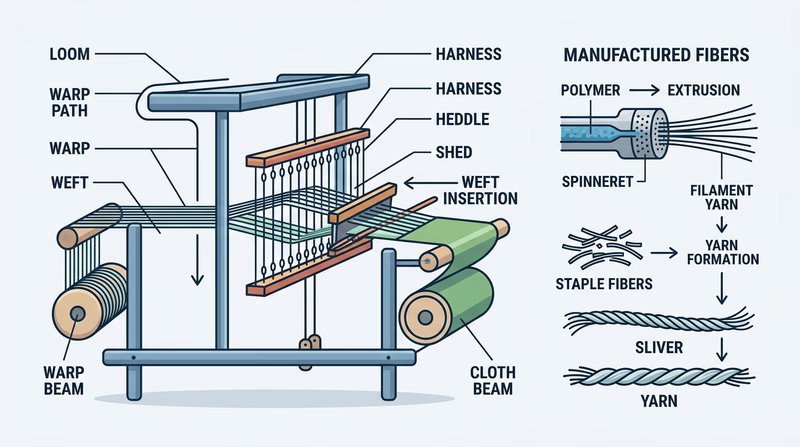
Warp
Warp yarns run lengthwise in a woven fabric. They stay under tension on the loom and act like the fabric’s basic framework.
Harness
A harness is the frame on a loom that holds heddles. By raising or lowering harnesses, the loom changes which warp yarns move.
Heddle
A heddle is the part that guides individual warp yarns and helps keep them separated and controlled.
Shed
The shed is the opening created between raised and lowered warp yarns. That opening allows the filling yarn to pass through.
Loom
A loom is the device used to weave fabric. It can be hand-operated or power-driven.
Yarn
Yarn is a continuous strand made by twisting fibers together. It is the material most weaving and knitting processes use to build fabric.
Spindle and Distaff
A spindle is a rod used in hand spinning to twist and wind yarn. A distaff holds the loose fibers that are being drawn out and spun.
🎬 Video: Loom and Weaving Terminology (video) — https://youtu.be/QNEB-fjMauc?si=zEm50ZTr7PgymZCE
This video is most useful for the loom-related words: warp, harness, heddle, shed, and loom.
Terms Connected to Fiber Types
Aramid
Aramid is a very strong synthetic fiber that resists high temperatures. The pamphlet glossary points to Kevlar and Nomex as examples. These fibers show up in protective gear such as firefighter clothing and other high-performance products.
Spandex
Spandex is a highly elastic synthetic fiber. It can stretch far and then recover toward its original length.
Carbon Fibers
Carbon fibers are strong, stiff, lightweight fibers made from nearly pure carbon. They are used where high strength and low weight matter.
Cellulose
Cellulose is a natural substance found in plant cell walls. It is the raw material behind cotton and flax, and it is also used to make fibers such as rayon, acetate, and lyocell.
Sericulture
Sericulture means raising silkworms to make silk. It connects a finished luxury fabric back to an agricultural and biological process.
Terms Connected to Fiber Preparation and Manufacturing
Sliver
A sliver is a loose rope of fibers produced during carding or combing before the fibers are fully spun into yarn.
Staple
Staple means short fiber length. Cotton, wool, and flax are staple fibers. Manufactured fibers can also be cut into staple lengths.
Spinneret
A spinneret is a nozzle or plate with tiny holes through which a liquid is extruded to make manufactured fibers. The pamphlet compares it to a shower head.
Extrusion
Extrusion is the process of forcing material through an opening to form a shape. In textiles, it often refers to pushing a fiber-forming liquid through a spinneret.
Terms Connected to Fabric Construction and Finishing
Nonwoven
A nonwoven fabric is made by matting, tangling, fusing, gluing, or melting fibers together rather than weaving or knitting them.
Worsted
Worsted refers to a tightly woven wool fabric made from long, combed fibers. The result is smoother and firmer than bulkier woolen fabrics.
Greige Goods
Greige goods, also spelled gray goods, are unfinished fabric straight from the loom or knitting machine before finishing treatments such as bleaching, dyeing, or waterproofing.
An Easy Way to Study the Terms
Group the words instead of memorizing them randomly- Loom parts and weaving action: warp, harness, heddle, shed, loom
- Fiber formation and prep: sliver, staple, spindle, distaff, yarn, spinneret, extrusion
- Fiber types: aramid, spandex, carbon fibers, cellulose
- Special textile concepts: sericulture, nonwoven, worsted, greige goods
Once you can talk like a textile maker, the next step is to compare the strengths, weaknesses, and environmental concerns tied to different fiber groups.
Req 5 — Compare Fibers and Their Footprint
There is no perfect fiber category. Every textile choice involves tradeoffs in comfort, durability, cost, care, and environmental impact. This requirement is about comparing those tradeoffs honestly.
Compare the Main Fiber Categories
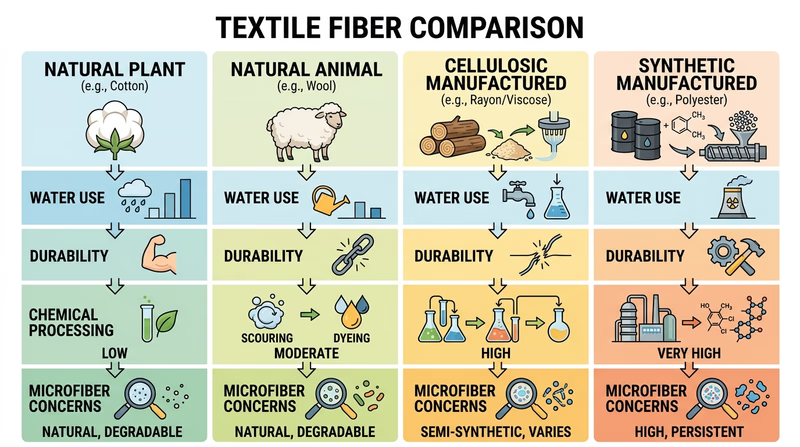
| Fiber category | Advantages | Disadvantages |
|---|---|---|
| Natural plant fibers | breathable, often absorbent, familiar feel | may wrinkle, may shrink, some crops need lots of water or chemicals |
| Natural animal fibers | warm, resilient, often excellent insulation | can be expensive, may need special care, involves animal production systems |
| Cellulosic manufactured fibers | soft, drapey, often absorbent, plant-based source | processing can be chemical-intensive, some versions wrinkle or weaken when wet |
| Synthetic manufactured fibers | durable, quick-drying, stretch or weather performance can be engineered | often petroleum-based, may trap odor or heat, may shed microfibers |
What Each Group Does Well
Natural Plant Fibers
Cotton and linen are comfortable, breathable, and common. They work well for warm-weather clothing and home textiles. Their downside is that they may wrinkle, shrink, or take time to dry, and some plant-fiber agriculture can use large amounts of water, fertilizer, and pesticides.
Natural Animal Fibers
Wool and silk show how strong natural fibers can be. Wool insulates well and can recover its shape nicely. Silk is smooth and strong for its weight. Their downsides often include price, special-care needs, and questions about land use, animal treatment, and processing.
Cellulosic Manufactured Fibers
Rayon, acetate, and lyocell begin with cellulose, usually from wood pulp or other plant sources. They often feel soft and drape well. Their main tradeoff is that turning cellulose into fiber may require significant processing, solvents, and water.
Synthetic Manufactured Fibers
Polyester, nylon, acrylic, olefin, and spandex are some of the workhorses of modern textiles. They are durable and can be engineered for stretch, water resistance, or strength. The drawbacks often include dependence on petrochemicals and the shedding of synthetic microfibers during wear and washing.
🎬 Video: The Ultimate Fabric Guide - The Differences Between Natural vs Synthetic vs Semi-Synthetic Fibers (video) — https://youtu.be/lcq9tPI-W-c?si=7pT187LPR6ZCW2c0
Use this video to compare categories, but do not stop at repeating its points. Tie the tradeoffs back to real products you use.
Ecological Concerns to Discuss
You need at least four. Here are several strong ones:
1. Water Use
Growing some textile crops and processing some fabrics can require large amounts of water. Dyeing and finishing can also use a lot of water.
2. Chemical Use
Pesticides, fertilizers, dyes, finishes, and processing chemicals can affect soil, air, and water if they are not handled well.
3. Energy Use and Carbon Emissions
Manufacturing fibers, running mills, transporting materials, and caring for clothing all require energy. Repeated washing, drying, and ironing add more over a textile item’s lifetime.
4. Microfiber Pollution
Synthetic textiles can release tiny fibers during washing. Those microfibers can move into waterways and the environment.
5. Waste and Fast Fashion
Cheap, short-lived garments are often thrown away quickly. That creates landfill waste and increases the demand for more raw materials and more production.
6. Durability and Repair
A textile that lasts longer and can be repaired may create less impact over time than a cheaper item that fails quickly.
A Better Textile Decision
Think beyond price alone- Will it last a long time?
- Is the fiber choice right for the job?
- Can it be washed and dried efficiently?
- Can it be repaired, reused, or handed down?
- Does it avoid unnecessary blends that make recycling harder?
Once you understand materials and impact, the badge ends by asking you to look ahead at the people who build careers around textiles every day.
Req 6 — Explore Textile Careers
Many Scouts hear “textiles” and think only about fashion design. The industry is much bigger than that. Textile work includes chemistry, machinery, safety gear, sports equipment, interiors, manufacturing, testing, sales, sourcing, sustainability, and research.
Five Career Possibilities to Consider
Here are five strong examples you could discuss with your counselor.
1. Textile Engineer
Textile engineers help design fibers, yarns, fabrics, or manufacturing systems. They may work on protective gear, medical materials, outdoor equipment, or industrial textiles.
2. Textile Designer or Fabric Designer
Designers create patterns, colorways, surface prints, or fabric concepts for clothing, interiors, or specialty products.
3. Quality Control or Testing Specialist
These specialists test fabrics for strength, shrinkage, colorfastness, abrasion resistance, flame resistance, or other performance standards.
4. Production Manager
A production manager helps keep textile manufacturing on schedule, solves workflow problems, and balances cost, quality, and deadlines.
5. Sustainability or Materials Specialist
This role focuses on sourcing, waste reduction, recycling, environmental impact, and smarter material choices.
Two Positions You Might Explore More Deeply
Pick the two that genuinely interest you. Then explain three things for each one: education, training cost, and daily duties.
Example: Textile Engineer
- Education: Often a four-year college degree in textile engineering, materials science, mechanical engineering, or a related field.
- Cost of training: Varies widely by school, scholarships, and whether the program is public or private.
- Specific duties: Testing materials, improving manufacturing processes, choosing fibers, solving failure problems, and designing products that meet performance goals.
Example: Quality Control Specialist
- Education: May range from technical training or a two-year degree to a four-year degree, depending on the employer and the kind of testing involved.
- Cost of training: Usually lower than a full engineering degree, but it depends on the program and certifications.
- Specific duties: Running tests, recording data, inspecting samples, checking standards, and reporting whether materials pass or fail.
🎬 Video: Careers in the Fashion & Textiles Industry (video) — https://youtu.be/uumtJp43Kfg?si=lOoILqksN5TWYQjK
🎬 Video: Want to Work in the Textiles Industry? (video) — https://youtu.be/Z-WValUr6z8
🎬 Video: Textile Engineering Careers (video) — https://www.youtube.com/shorts/rClr3NSF-CM?feature=share
🎬 Video: Day in the Life of a Textile Engineer (video) — https://youtu.be/Ify9Fo2IhB4
These official resources are most useful for hearing how people describe their own paths into the field.
How to Give a Strong Explanation
Career Report Framework
Use this structure for each job you discuss- What does this person actually do?
- What kind of workplace are they in?
- What education or training is common?
- What might the cost of that path look like?
- Why does this career interest you personally?
You have finished the badge requirements. The final page takes you beyond the badge into deeper topics, real-world experiences, and organizations worth exploring.
Extended Learning
Congratulations
You have done more than learn fabric vocabulary. You have looked at textile materials closely, compared their strengths and weaknesses, and seen how a finished product depends on fiber choice, structure, and finishing. That is exactly how people in the textile world think.
The best part is that textiles reward curiosity. Once you start noticing weave, stretch, drape, abrasion, insulation, or stitching, ordinary objects stop feeling ordinary. A rain jacket, theater costume, sail, or climbing rope can all become a lesson in smart material choice.
Smart Textiles and Wearable Technology
Some of the most interesting textile work today combines fabric with electronics, sensors, or advanced finishes. A smart textile might monitor heart rate, change temperature response, improve athlete comfort, or increase worker safety.
This field matters because fabric covers large areas of the human body and can move with the wearer. Designers and engineers are experimenting with conductive yarns, flexible sensors, heated garments, and fabrics that respond to light, pressure, or moisture.
Performance Textiles in Tough Environments
Textiles become especially fascinating when failure is not an option. Firefighter gear, marine sails, tents for extreme weather, military equipment, and aerospace materials all depend on specific fiber choices.
An outdoor shell has to balance water resistance, breathability, abrasion resistance, and flexibility. A racing suit may need heat resistance. A climbing sling must hold heavy loads while staying light. In each case, the textile is not just decoration. It is part of the equipment system.
Circular Design and Repair
One of the biggest challenges in the textile world is waste. Many products are made quickly, worn briefly, and discarded. Circular design tries to change that by emphasizing durability, repair, reuse, recycling, and smarter material choices.
You can practice this idea right now. Learn basic mending, patch outdoor gear, replace a zipper pull, or turn worn fabric into a smaller useful item. Repair is part of textile knowledge too.
Fiber Arts as Culture and Storytelling
Textiles are also art and history. Quilting, weaving, embroidery, indigo dyeing, basketry, rug making, and ceremonial cloth all carry stories about families, regions, and traditions. A fabric can be practical and deeply meaningful at the same time.
If you want to keep exploring textiles, do not limit yourself to factories and science labs. Museums, cultural centers, historical villages, and local craft guilds often reveal just as much.
Real-World Experiences
Visit a Textile or Fashion Museum
Take a Weaving, Sewing, or Dye Workshop
Tour a College Program in Textiles, Fashion, or Materials
Repair a Piece of Gear Instead of Replacing It
Organizations
Museum and study collection focused on textiles from around the world, now part of George Washington University.
Organization: The Textile Museum — https://museum.gwu.edu/
Global nonprofit focused on more responsible fiber and material systems, including sustainability and sourcing.
Organization: Textile Exchange — https://textileexchange.org/
Professional association focused on textile chemistry, testing, color, and performance standards.
Organization: AATCC — https://www.aatcc.org/
Industry group that helps explain the U.S. textile supply chain, manufacturing, and policy issues.
Organization: National Council of Textile Organizations — https://www.ncto.org/
Organization supporting artists, makers, and educators who work with dyeing, printing, stitching, weaving, and textile surfaces.
Organization: Surface Design Association — https://www.surfacedesign.org/