Req 2 — From Fiber to Fabric
This requirement gives you the foundation for the rest of the badge. You will gather real samples, compare what they are made from, trace how fibers become yarn and fabric, and then use that knowledge to make a smart buying choice. If Req 1 taught you why textiles matter, Req 2 shows you how textile thinking actually works.
Requirement 2a: Build a Swatch Set
A swatch is a small sample that lets you compare materials side by side. This part works best when you can touch, bend, wrinkle, stretch, and closely inspect each sample. Ask at a fabric store, sewing space, upholstery shop, thrift store, or at home from damaged or scrap items.
What to Look For in Each Swatch
As you collect your five samples, notice:
- how the surface feels: smooth, fuzzy, slick, crisp, stretchy, or bulky
- how it reacts when you crumple it: does it spring back or stay wrinkled?
- how heavy it feels for its thickness
- whether the fabric seems woven, knitted, or nonwoven
- whether it looks matte or shiny
A Balanced Swatch Set
Choose samples that are easy to compare
- Natural sample 1: Cotton or linen work well because they are common and easy to recognize.
- Natural sample 2: Add a contrasting sample such as wool or silk so the feel is clearly different.
- Synthetic sample 1: Polyester is easy to find in athletic wear, fleece, and home textiles.
- Synthetic sample 2: Nylon, acrylic, olefin, or spandex can show strength, loft, or stretch.
- Cellulosic sample: Rayon, acetate, or lyocell often drape softly and may feel different from both cotton and polyester.
Requirement 2b: Explain the Fibers
This is where your swatch set becomes evidence. Your counselor wants to hear where each fiber comes from, how it usually behaves, and what makes one category different from another.
Natural Fibers
Natural fibers come from plants or animals.
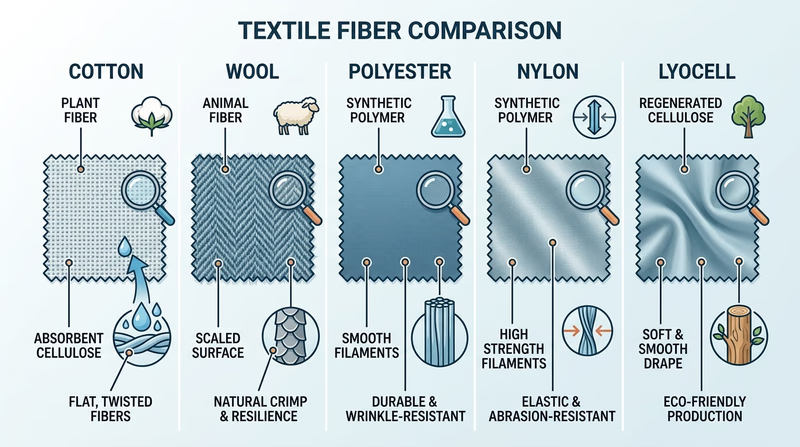
- Cotton comes from the seed hairs of the cotton plant. It is breathable, absorbent, and comfortable, but it can wrinkle and may dry slowly.
- Linen comes from flax. It is strong, cool in warm weather, and crisp, but it wrinkles easily.
- Wool comes from animal fleece, usually sheep. It insulates well, can stay warm when damp, and often springs back well, but some wool can feel scratchy.
- Silk comes from silkworm cocoons. It is smooth, fine, and strong for its weight.
Cellulosic Manufactured Fibers
Cellulosic manufactured fibers begin with cellulose, the natural material found in plant cell walls. The source is still plant-based, but people dissolve or chemically process that cellulose and form it into new fibers.
- Rayon usually drapes softly and absorbs moisture well.
- Acetate often has a smooth, silky look and is used in linings or dress fabrics.
- Lyocell is also cellulose-based and is known for softness, good drape, and improved strength.
Synthetic Manufactured Fibers
Synthetic fibers are made from chemicals, usually derived from petroleum or natural gas.
- Polyester is durable, quick-drying, and wrinkle resistant.
- Nylon is strong and abrasion resistant.
- Acrylic feels wool-like and holds color well.
- Olefin is lightweight and resists moisture.
- Spandex stretches dramatically and then recovers.
The Big Difference
A cellulosic manufactured fiber starts with plant-based cellulose and is processed into fiber form. A synthetic manufactured fiber starts with man-made chemicals and is built into fiber form from those chemicals.
🎬 Video: Natural vs Synthetic Fibers (Which to Choose and Why) (video) — https://youtu.be/cRLPUAPCfuo
Watch for the tradeoffs in the video, not just the labels. No fiber is automatically “best.” The better question is: best for what job?
Requirement 2c: From Raw Fiber to Yarn to Fabric
This process changes loose material into something useful and durable.
Step 1: Prepare the Fiber
Raw fibers usually need cleaning and organizing first. Cotton must be separated from seeds and cleaned. Wool is scoured to remove dirt and grease. Flax must be retted and processed to free the fibers. Manufactured fibers start as a liquid pushed through a spinneret, which works like a nozzle with tiny holes.
Step 2: Align the Fibers
Before spinning, many fibers are carded or combed so they point in roughly the same direction. Carding opens and straightens the mass. Combing goes farther by removing shorter fibers and producing a cleaner, more even result.
Step 3: Spin the Yarn
Spinning draws out fibers, twists them together, and winds them into a continuous strand. Twist adds strength. Without enough twist, the fibers pull apart too easily.
Step 4: Turn Yarn into Fabric
Yarn can become fabric in several ways:
- Weaving interlaces lengthwise warp yarns with crosswise weft or filling yarns.
- Knitting forms loops that interlock with other loops.
- Bonding or felting joins fibers without weaving or knitting.
Step 5: Finish the Fabric
Fresh fabric is often unfinished. It may be dyed, softened, preshrunk, waterproofed, brushed, flame resistant, or given other treatments depending on its purpose.
🎬 Video: From Cotton to Yarn (video) — https://youtu.be/vFaNiTlHeCY
🎬 Video: Weaving Process (video) — https://youtu.be/NIt9SGk55b4
🎬 Video: Knitting Process (video) — https://youtu.be/yRXuKFy89Mg
🎬 Video: Complete Process of Textile Manufacturing Fiber to Complete Garments (video) — https://youtu.be/5nUjGNDImIk
Requirement 2d: Choose a Smart Purchase
A smart answer starts with the item and the job it must do. A winter hat, soccer jersey, bath towel, dress shirt, and backpack do not need the same fiber properties.
Match the Fiber to the Job
If you were buying a hiking base layer, you might want a polyester or wool blend because it handles moisture better than cotton. If you were buying bedsheets for hot weather, you might choose cotton or linen for breathability. If you wanted leggings or athletic gear, you might look for spandex blended with another fiber to add stretch and recovery.
A strong answer might sound like this: If I were buying a backpack, I would want a strong synthetic fiber such as nylon or polyester because it needs abrasion resistance, weather resistance, and durability. I would not choose a delicate fiber like silk because the job is completely different.
You have now worked from sample collection to material choice. Next you get to pick two hands-on projects that let you explore textile work more directly.