Req 3g — Identify Fibers
This option asks you to act like a textile investigator. Instead of trusting a label, you look for physical evidence in the fiber itself. That skill matters because fibers that seem similar on the surface can behave very differently in use.
Two Ways to Identify Fibers
Microscope Identification
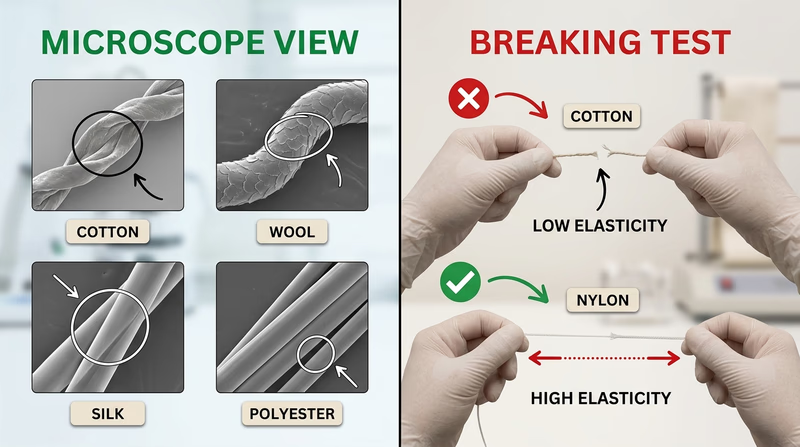
Under magnification, some fibers have distinctive shapes or surface features. Cotton often looks different from wool, and manufactured fibers may appear smoother or more uniform. This method is about careful observation.
🎬 Video: Identification of Basic Textile Fibers by Polarized Light Microscopy (video) — https://youtu.be/BbeZvRi3eUI
If you use a microscope, focus on what you can clearly describe, not on pretending certainty you do not have. Your counselor will care more about honest observation than about sounding like a lab report.
Breaking Test
A breaking test compares how fibers react when pulled. Some stretch more before breaking. Some snap quickly. Some feel stronger, smoother, or more resilient. The point is to compare behavior, not just guess.
What to Observe
Fiber Clues
Notice behavior, not just appearance
- Surface: smooth, fuzzy, scaly, twisted, or uniform
- Strength: easy to break or surprisingly strong
- Stretch: little stretch, moderate stretch, or high stretch
- Recovery: springs back or stays deformed
- Feel: slick, dry, soft, crisp, or springy
Build a Careful Demonstration
Use known samples if possible, such as cotton thread, wool yarn, polyester thread, or nylon cord. Compare at least a couple of clearly different fibers so your observations are meaningful.
After these project choices, the guide turns back to a full requirement page focused on textile terms you will hear throughout the field.