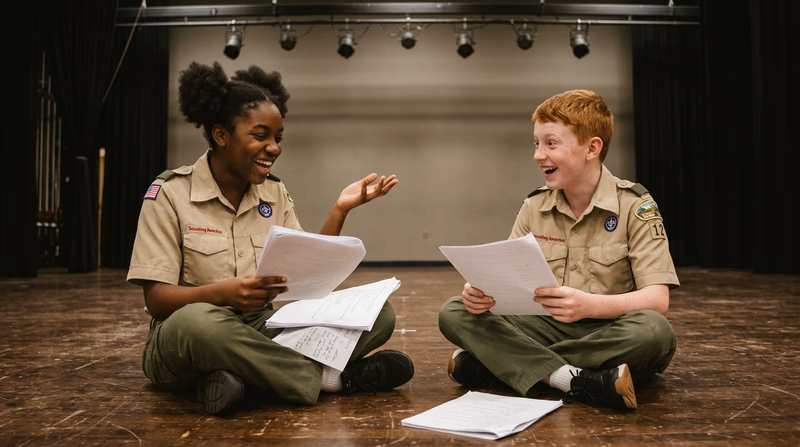
Req 2 — Writing a One-Act Play
Now it is your turn to create. Writing a play is different from writing a story or an essay — everything has to come through what people say and do on stage. There is no narrator telling the audience what a character is thinking. You have to show it through dialogue, action, and the choices your characters make.
Do not worry if you have never written a play before. This guide will walk you through the three essential ingredients the requirement asks for: a main character, a conflict, and a climax.
The Three Essential Ingredients
1. A Main Character (Protagonist)
Your main character is the person the audience follows through the story. They should want something — this desire is what drives your entire play. The want does not have to be dramatic. It could be as simple as wanting to win a cooking contest, impress a new friend, or find a lost dog.
Make your main character someone the audience can root for. Give them a personality, a way of speaking, and at least one trait that makes them feel real. You do not need a huge cast — many great one-act plays have just two or three characters.
2. A Conflict
Conflict is what stands between your character and what they want. Without conflict, there is no drama — just people having a nice time. Conflict can come from several places:
- Person vs. Person — Another character actively opposes your protagonist (a rival, an authority figure, a friend who disagrees)
- Person vs. Self — Your character struggles with their own fears, doubts, or choices
- Person vs. Situation — Circumstances create obstacles (a storm, a deadline, a rule)
The best plays often combine more than one type. A Scout trying to earn a cooking award (person vs. situation) might also have to deal with a competitive teammate (person vs. person) and their own self-doubt (person vs. self).
3. A Climax
The climax is the turning point — the moment of highest tension when the conflict comes to a head and something has to change. Everything in your play should build toward this moment. After the climax, the story wraps up quickly.
Think of the climax as the moment when the audience leans forward in their seats. Does the character succeed or fail? Do they make a choice that changes everything?

Formatting Your Script
A play script looks different from a regular story. Here is the standard format:
Character names are written in capital letters, followed by a colon or period, then their dialogue:
MAYA. I told you we should have left earlier. Now we are going to miss the whole thing.
JORDAN. Relax. The show does not start for twenty minutes.
MAYA. (checking her watch) It started ten minutes ago.
Stage directions go in italics or parentheses. They tell the actors what to do physically:
(JORDAN drops the map and stares at MAYA.)
JORDAN. You are kidding me.
Building Your Play Step by Step
Here is a practical process to get from a blank page to a finished script:
Step 1: Start with “What If?”
Every good play starts with a question. What if a Scout got locked in a museum overnight? What if two best friends both wanted the same role in the school play? What if someone found a mysterious letter hidden in an old book?
Step 2: Sketch Your Characters
Write a short description of each character — their name, age, personality, and what they want. Two or three characters are plenty for a one-act play.
Step 3: Map the Arc
Draw a simple diagram:
- Beginning — Introduce your character and their world
- Inciting incident — Something happens that sets the conflict in motion
- Rising action — Tension builds as the character tries to solve the problem
- Climax — The moment of greatest tension and decision
- Resolution — The aftermath (keep it short)
Step 4: Write the First Draft
Do not aim for perfection. Get the story down. You can fix awkward lines later.
Step 5: Read It Aloud
Grab some friends and read through the script together. Time it — remember, it needs to be at least 10 minutes. A good rule of thumb: one page of script equals roughly one minute of stage time.
Step 6: Revise
Cut lines that do not move the story forward. Add moments where the audience can laugh, gasp, or feel something. Make sure every character sounds like a distinct person, not just the same voice with different names.
How Long Is 10 Minutes?
Ten minutes of stage time is roughly 8–12 pages of script, depending on how much action versus dialogue your play contains. Here is a rough breakdown:
- Pages 1–2: Setup — introduce your character and their world
- Pages 3–4: Inciting incident — the conflict kicks in
- Pages 5–8: Rising action — obstacles pile up, tension builds
- Pages 9–10: Climax and resolution — the big moment and its aftermath
One-Act Play Checklist
Make sure your script has all of these before sharing it with your counselor
- A clear main character with a specific want or goal.
- A conflict that creates obstacles for the main character.
- A climax where the tension peaks and something changes.
- Dialogue that sounds natural when read aloud.
- Stage directions that help actors know what to do.
- A running time of at least 10 minutes (approximately 8+ pages).
Explore More Resources
Young Playwrights Inc. A national organization that supports young writers in creating original plays, with contests and workshops. Playwriting 101 — The Basics Free online tutorials covering script format, character development, and story structure for beginning playwrights.