Req 4 — Mime & Pantomime
Mime and pantomime are the art of telling a story using only your body — no words, no props, no set. Everything the audience “sees” is created by your movements, gestures, facial expressions, and physical illusions. It is one of the purest forms of acting because you cannot rely on dialogue to communicate. Your body has to do all the work.
Your counselor will choose one of the following six scenarios for you to perform. Since you will not know which one they will pick, you should prepare for all of them.
The Six Scenarios
a. You have come into a large room. It is full of pictures, furniture, and other things of interest.
This scenario is about discovery and reaction. The audience should “see” the room through your eyes. Key physical skills:
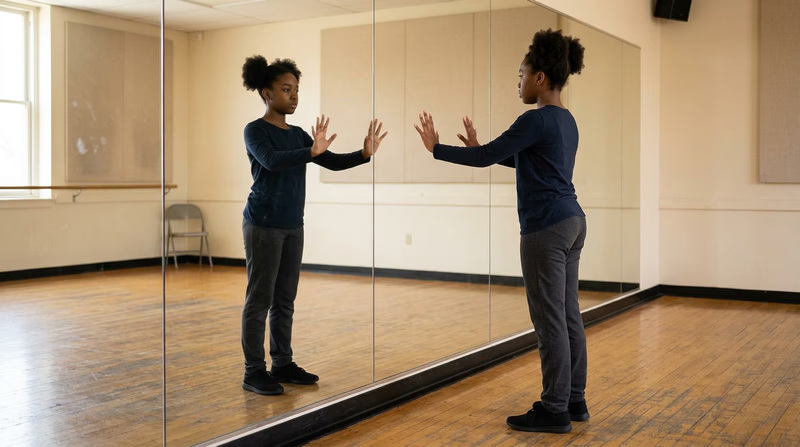
- Open the door (use the “mime wall” technique — press your hand flat against an imaginary surface)
- React to the size of the room (step back slightly, widen your eyes, look up and around)
- Examine objects at different heights and distances
- Show different emotions for different objects (curiosity, surprise, delight, confusion)
b. As you are getting on a bus, your books fall into a puddle. By the time you pick them up, the bus has driven off.
This scenario tells a small story with a clear beginning, middle, and end. Key moments:
- Show the weight and size of the books you are carrying
- Establish the bus arriving (look down the street, check time, step toward the curb)
- The drop — react with shock and dismay
- Picking up wet books — show the weight of waterlogged pages, the unpleasant texture
- The bus leaving — look up, reach out, slump in defeat
c. You have failed a school test. You are talking with your teacher, who does not buy your story.
This is a two-character scene performed solo. You need to shift between your character and the implied teacher. Key techniques:
- Show nervousness before the conversation begins
- Use different body positions for talking vs. listening
- React to the teacher’s unseen responses (deflating as your excuses fail)
- Show the emotional arc: hope → effort → defeat
d. You are at camp with a new Scout. You try to help them pass a cooking test. The Scout learns very slowly.
This scenario is about patience and frustration. Physical comedy works well here:
- Demonstrate a cooking action clearly, then react as the new Scout gets it wrong
- Show increasing frustration through body language while maintaining a helpful attitude
- Use specific, recognizable cooking actions (stirring, flipping, tasting)
- End with either success or humorous resignation
e. You are at a banquet. The meat is good. You don’t like the vegetable. The dessert is ice cream.
This scenario is all about contrasting reactions to food. Key skills:
- Establish the formal setting (sit down, unfold a napkin, look around the table)
- Show genuine enjoyment of the meat (savor it, take another bite)
- Show disgust at the vegetable (try to hide your reaction, push it around the plate)
- Show pure delight at the ice cream (eyes light up, eat eagerly)
f. You are a circus performer such as a juggler, high-wire artist, or lion tamer doing a routine.
This is the most physically demanding option and lets you be creative:
- Juggler: Show the weight and trajectory of invisible objects, building from two to three or more
- High-wire artist: Establish the height (look down nervously), show the balance and tension in your body, include a near-fall and recovery
- Lion tamer: Show the power and danger of the invisible animal, use a chair and whip (mimed), demonstrate bravery mixed with fear
Fundamental Mime Techniques
No matter which scenario your counselor picks, these core techniques will help you perform convincingly:
The Fixed Point
This is the most important mime technique. When you touch an imaginary object (a wall, a table, a door handle), your hand must stay in that exact spot in space. If your hand drifts, the illusion breaks. Practice by placing your palm on a real wall, then removing the wall — keep your hand exactly where it was.
Weight and Resistance
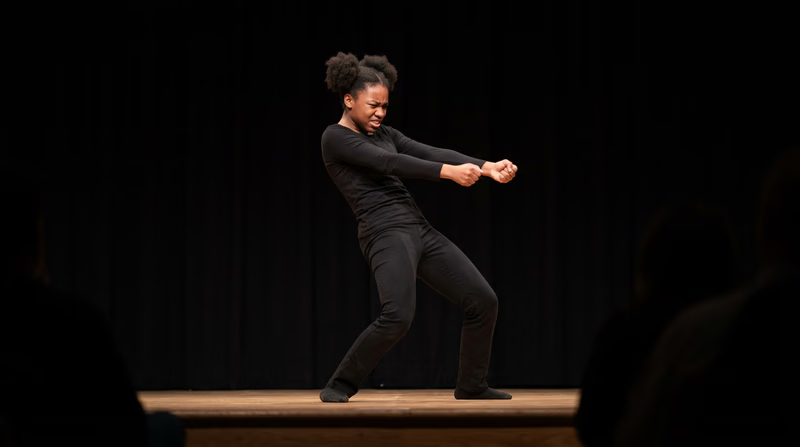
Real objects have weight and texture. A mimed suitcase should make your arm strain. A mimed glass of water should tilt carefully. A mimed rope should pull against you. Show the effort that interacting with real objects would require.
Isolation
Isolation means moving one part of your body while keeping everything else still. This creates the illusion that external forces are acting on you. For example, when “pushing” against a wall, your hands stay fixed while your body leans forward — it looks like the wall is resisting you.
Facial Expression
Your face is your most powerful tool. Every emotion — surprise, disgust, joy, frustration, fear — must be readable from the back row. Practice exaggerating your expressions in a mirror until they feel slightly “too big.” On stage, that will be just right.
Preparing for the Unknown
Since your counselor chooses the scenario, you should practice all six. But more importantly, practice the fundamental techniques — fixed point, weight, isolation, and facial expression. If you have those skills down, you can adapt to any scenario your counselor selects.
Mime Performance Prep
Get ready for your counselor meeting
- Practice each of the six scenarios at least twice.
- Rehearse in front of a mirror to check your facial expressions and hand positions.
- Perform for a friend or family member and get feedback.
- Time each scenario — aim for 1–3 minutes of clear, unhurried storytelling.
- Wear simple, dark clothing that does not distract from your movements.
- Warm up your body before performing — stretch, loosen your shoulders, shake out your hands.
Explore More Resources
International Mime Association Resources about the art of mime, including history, technique, and profiles of famous mime artists.