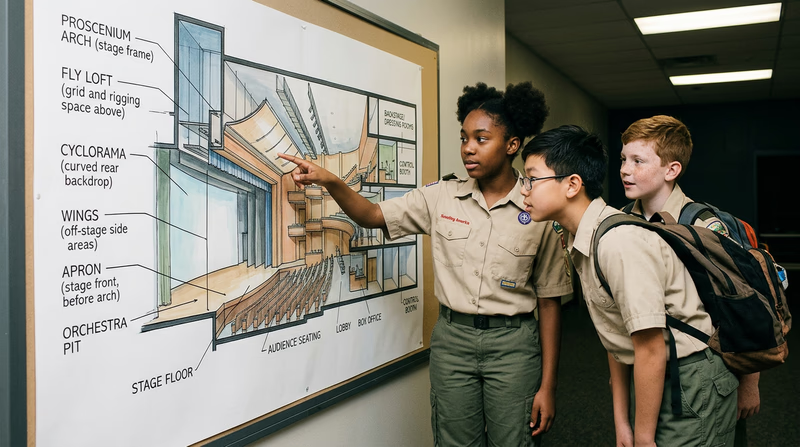
Req 5 — Theater Terminology
Every profession has its own vocabulary, and theater is no exception. Knowing these terms is essential for communicating clearly with directors, designers, and crew members. When someone says “cross downstage left,” everyone in the room needs to know exactly what that means — no confusion, no wasted time.
This requirement asks you to explain a specific list of theater terms. Let’s go through each one.
Stage Types
Proscenium Arch
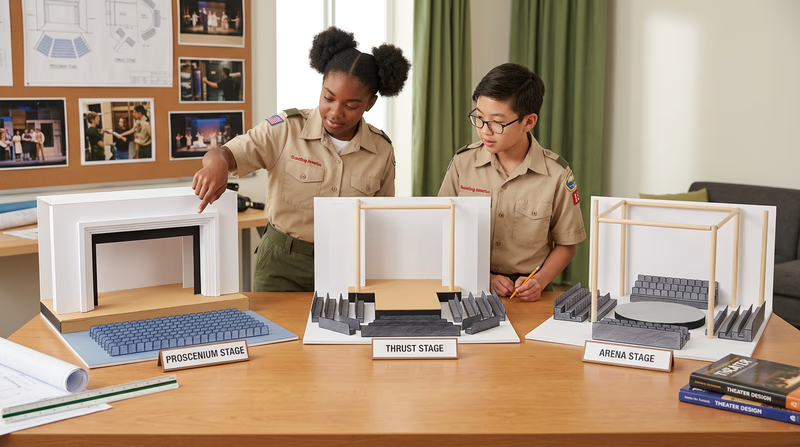
The proscenium arch is the most common type of theater stage. It is the frame — like a picture frame — that separates the stage from the audience. The audience sits on one side and looks through the arch at the performance. Think of it as looking through a window into another world. Most school auditoriums and Broadway theaters use proscenium staging.
The arch creates a clear front to the stage, which makes it easy for the audience to focus and for designers to create illusions (since they only need to worry about one viewing angle).
Central or Arena Staging
In arena staging (also called “theater in the round”), the audience sits on all four sides of the performance space. The stage is in the center, like a boxing ring or a basketball court. There are no large set pieces because they would block someone’s view. Arena staging creates an intimate, immersive experience where the audience feels very close to the action.
Thrust Staging
A thrust stage extends out into the audience, with seating on three sides. The back of the stage connects to a backstage area (sometimes with a proscenium arch behind it). Thrust stages are the oldest form of staging — Shakespeare’s Globe Theatre used a thrust. They give the audience a closer connection to the actors than a proscenium while still allowing some scenic elements at the back.
Stage Directions
Stage directions are always given from the actor’s perspective — as if you are standing on stage, facing the audience.
Center Stage — The exact middle of the performance area. The strongest position on stage because every audience member can see you clearly.
Stage Right — The actor’s right side (the audience’s left). When a director says “cross stage right,” you walk to your right.
Stage Left — The actor’s left side (the audience’s right).
Downstage — The area closest to the audience. In older theaters, the stage was actually sloped (raked) downward toward the audience, which is where the term comes from.
Upstage — The area farthest from the audience (the back of the stage). The stage sloped upward away from the audience.
Backstage and Scenic Elements
Stage Crew
The stage crew includes all the people who work behind the scenes to make a production happen. This includes stagehands who move scenery, prop runners, fly operators, dressers who help actors with quick costume changes, and anyone else working backstage during a performance. The stage crew wears all black so they are invisible to the audience when they move set pieces during scene changes.
Flies (Fly System)
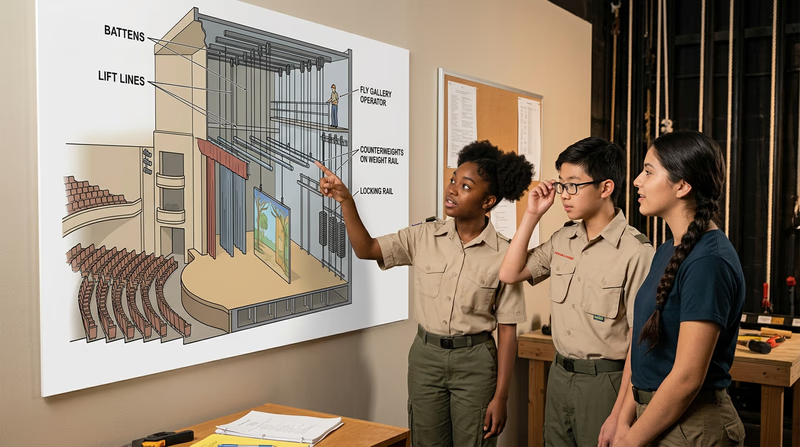
The fly system is the rigging above the stage used to raise and lower scenery, curtains, and lighting pipes. It consists of pipes (battens), cables, pulleys, and counterweights. When a piece of scenery needs to appear or disappear, it is “flown in” (lowered from above) or “flown out” (raised up out of sight). The area above the stage where the fly system operates is called the “fly loft” or “fly space.”
Portal
A portal is a frame or opening at the front of the stage, just behind the proscenium arch. Portals can be adjusted to make the stage opening smaller or to create a specific visual frame for the production. Some theaters use multiple portals at different depths to create a sense of perspective.
Cyclorama (Cyc)
A cyclorama (usually called a “cyc,” pronounced “sike”) is a large, smooth, curved curtain or wall at the very back of the stage. It is usually white or light gray and is used as a surface for lighting effects — a blue wash to suggest sky, an orange glow for sunset, or projections of clouds, stars, or other images. When lit properly, a cyc creates the illusion of infinite depth.
Stage Brace
A stage brace is a device used to hold up flat scenery pieces. It is an adjustable metal or wooden support that attaches to the back of a flat at the top and anchors to the stage floor with a stage weight or stage screw. Without braces, flats would fall over.
Lighting Equipment
Spotlight
A spotlight produces a focused, controllable beam of light that can be aimed at a specific actor or area. Spotlights can be sharpened to a tight circle or softened to a wider pool. The most common type in theater is the ellipsoidal reflector spotlight (ERS), which has shutters that let you shape the beam precisely. You worked with spotlights if you chose the lighting design option in Requirement 3.
Floodlight
A floodlight produces a broad, even wash of light that covers a wide area. Unlike a spotlight, a floodlight cannot be focused to a tight beam. Floodlights are used to light backdrops, cycloramas, and large sections of the stage with general illumination. They provide the “base layer” of light that spots and specials add detail to.
Lighting Control Board
The lighting control board (also called a “light board” or “console”) is the computer or device that controls every lighting instrument in the theater. Each instrument is assigned a channel number, and the operator can set the brightness of each channel from 0 to 100 percent. Lighting cues (pre-programmed combinations of channels and levels) are stored in the board and recalled during the show, allowing complex lighting changes to happen with a single button press.
Sound Equipment
Sound Mixing Desk
The sound mixing desk (or mixing board, mixer, or console) is the control center for all audio in a production. Every microphone, sound effect, and music source has its own channel on the board. The operator adjusts volume, tone (equalization), and effects for each channel independently, blending them all together into what the audience hears through the speakers. During a musical, the sound operator might manage 20 or more open microphones simultaneously. You explored the mixing desk in detail in Requirement 3h.
Planning Tools
Ground Plans
A ground plan is a bird’s-eye-view scale drawing of the stage showing where every piece of scenery, furniture, and major prop is placed. Ground plans are drawn to a specific scale (typically 1/2 inch = 1 foot) and include the outline of the stage, the proscenium arch, sightlines, and all scenic elements. Directors use ground plans to plan blocking, and technical directors use them to build and place scenery. You created a ground plan if you chose set design in Requirement 3.
Sightlines
Sightlines are the imaginary lines drawn from the audience’s seats to the stage, representing what each audience member can see. Good sightlines mean every seat in the house has a clear view of the important action. Designers check sightlines from the worst seats (the far sides and the very back) to make sure nothing is blocked. If a piece of scenery obstructs a sightline, it needs to be moved or redesigned.
Putting It All Together
All of these terms describe pieces of the same puzzle. The stage type determines the audience’s relationship to the performance. The stage directions give everyone a common language for movement. The scenic elements and equipment create the world the audience sees and hears. And the planning tools ensure everything works together before opening night.
Study Guide
Organize these terms by category to help you remember them
- Stage types: proscenium arch, central/arena staging, thrust staging.
- Stage directions: center stage, stage right, stage left, downstage, upstage.
- People: stage crew.
- Scenic elements: flies, portal, cyclorama, stage brace.
- Lighting: spotlight, floodlight, lighting control board.
- Sound: sound mixing desk.
- Planning: ground plans, sightlines.
Explore More Resources
TheatreLinks — Glossary of Theater Terms A comprehensive glossary of hundreds of theater terms with clear definitions and illustrations. USITT — Resources for Students The United States Institute for Theatre Technology provides learning resources for students interested in all aspects of theater technology and design.