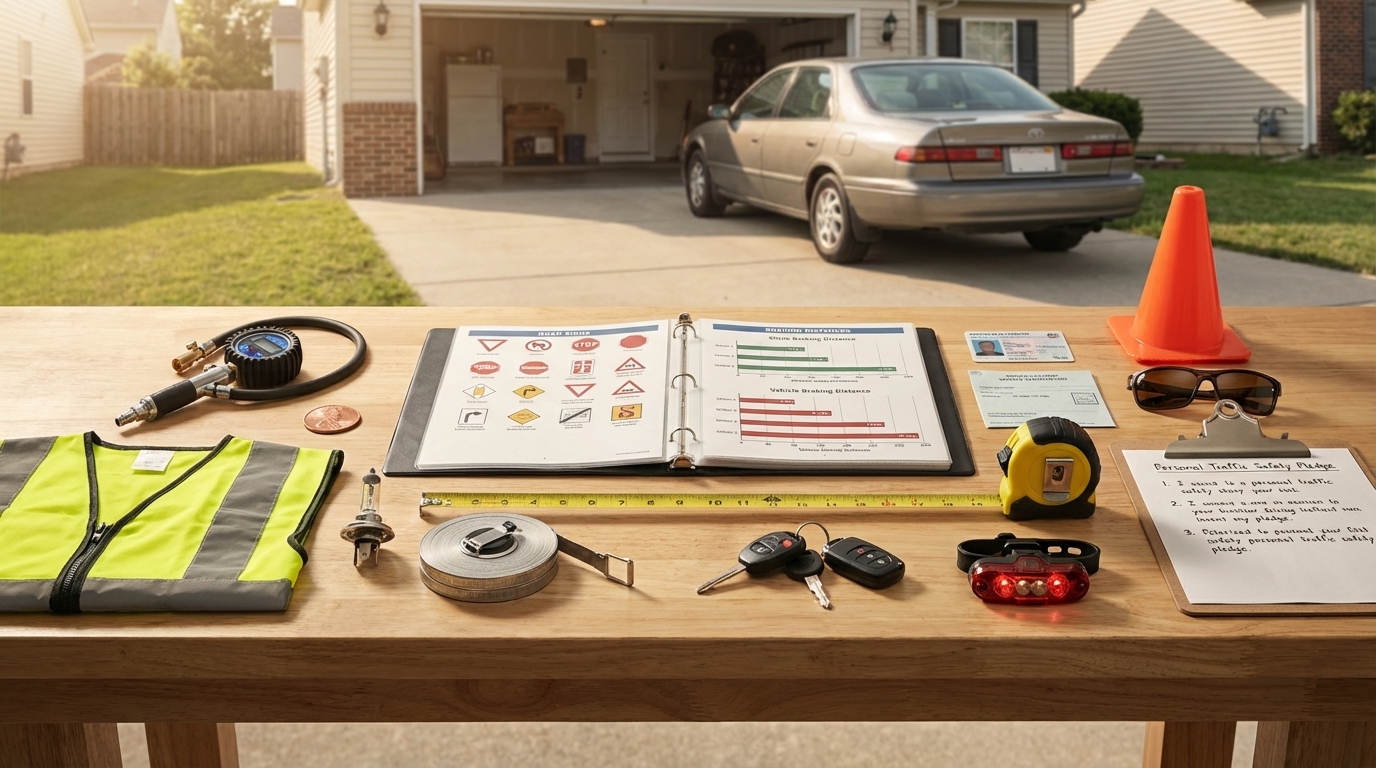
Traffic Safety Merit Badge — Complete Digital Resource Guide
https://merit-badge.university/merit-badges/traffic-safety/guide/
Introduction & Overview
Every trip on the road depends on hundreds of tiny decisions: where you look, how fast you go, when you stop, and how well you notice danger before it becomes a crash. Traffic Safety helps you understand those decisions from the driver’s seat, the passenger seat, the sidewalk, and the shoulder of the road. It is a badge about protecting lives, including your own.
You do not need a driver’s license to start learning traffic safety. Scouts ride in cars, walk near roads, bike through neighborhoods, cross parking lots, and depend on adults to make smart choices behind the wheel. This guide will help you see how distraction, impairment, equipment, laws, road design, and community habits all work together to make travel safer.
Then and Now
Then — Learning by Hard Experience
Early roads were built for horses, wagons, and pedestrians, not fast-moving cars. As automobiles became common in the early 1900s, many streets had no painted lanes, no traffic signals, no seat belts, and no standard signs. Crashes were often blamed only on “careless drivers,” even when the road itself was confusing or unsafe.
As traffic deaths climbed, communities began adding stop signs, driver’s licenses, speed laws, road markings, guardrails, and later seat belts and child safety seats. Traffic safety grew from a simple idea into a whole field that studies people, vehicles, and roads together.
Now — A System That Tries to Prevent Mistakes
Modern traffic safety is about building layers of protection. Cars have airbags, anti-lock brakes, backup cameras, and stronger passenger compartments. Roads use medians, rumble strips, reflective markings, and better intersection designs. Laws address impairment, distraction, child restraints, and school bus stops.
Even with all of that, people still make errors. That is why today’s best safety thinking assumes mistakes will happen and asks a tougher question: how do we keep one mistake from becoming a tragedy?
Get Ready! This badge will make you notice things most people ignore: worn tire tread, a glare-filled windshield, a dangerous blind spot, or a road sign that must be understood in a split second. Once you start seeing the road this way, you will never ride through town quite the same way again.
Kinds of Traffic Safety
Traffic safety is bigger than “good driving.” It includes several connected areas.
Driver Safety
This is the part most people think of first: staying focused, sober, rested, and calm while operating a vehicle. A safe driver scans ahead, follows the law, leaves space, and avoids risky decisions like texting or speeding.
Vehicle Safety
A car cannot protect you well if its lights are out, its tires are underinflated, or its passengers are unbelted. Vehicle safety includes restraint systems, crash-protection features, and routine checks that make sure the car is ready for the road.
Roadway Safety
Road designers shape how traffic moves. Intersections, shoulders, medians, signs, signals, and pavement markings all affect whether drivers can understand the road quickly and respond in time.
Shared-Road Safety
Drivers do not have the road to themselves. Bicyclists, pedestrians, school buses, motorcycles, and large trucks all have different needs and different vulnerabilities. Safe travel means noticing those differences before a conflict happens.
Community Safety
Communities can reduce crashes by changing behavior and changing systems. Public awareness campaigns, enforcement, school programs, safer crossings, and youth-led events all help create habits that save lives.
Now that you have the big picture, start with the choices that most quickly turn an ordinary drive into a dangerous one: distraction, alcohol and drugs, fatigue, and beginner mistakes.
Req 1 — Preventing Impaired Driving
A crash rarely starts with the impact. It usually starts earlier, when a driver looks down at a phone, gets behind the wheel after drinking, pushes through exhaustion, or makes a beginner mistake without realizing how fast the risk is growing. This requirement covers four ways judgment gets weakened before a vehicle ever leaves the lane.
- 1a — Distraction: what steals a driver’s attention
- 1b — Alcohol, drugs, and other substances: what changes reaction time and judgment
- 1c — Fatigue: what happens when a driver is too tired to be safe
- 1d — New-driver mistakes: what inexperience looks like on the road
Requirement 1a
Looking away for only a few seconds can mean traveling the length of a basketball court without really seeing the road. A distracted driver is dangerous because driving is not one skill. It is many skills happening at once: steering, scanning, judging speed, reading signs, watching mirrors, and predicting what everyone else might do next.
Common distractions
Five common distractions are easy to spot:
- Phones — texting, scrolling, calling, or using maps without setting them first
- Passengers — loud conversations, horseplay, or turning around to deal with people in the back seat
- Food and drinks — opening wrappers, balancing drinks, or cleaning spills
- Music and controls — searching playlists, changing volume, or adjusting climate controls too long
- Objects inside the vehicle — reaching for something that fell, checking a backpack, or looking for sunglasses
Distraction can be visual (eyes off the road), manual (hands off the wheel), or cognitive (mind off the task). Texting is especially dangerous because it combines all three.
How distraction causes crashes
A distracted driver may miss brake lights, drift out of a lane, roll through a stop sign, or fail to notice a pedestrian entering a crosswalk. Distraction also makes reaction time worse. If the brain is busy reading a message or arguing with a passenger, it notices danger later and starts braking later.
How to reduce distractions before the trip starts
Distraction-Prevention Routine
Set up the car before you start moving- Silence or store your phone: Put it on Do Not Disturb or place it where you cannot reach it.
- Set your route first: Program navigation before shifting into drive.
- Secure loose items: Water bottles, bags, and sports gear should not roll around the cabin.
- Set music and climate controls early: Make small changes only when stopped.
- Use your passengers wisely: Ask someone else to handle directions or messages if needed.
🎬 Video: Distracted Driving (video) — https://youtu.be/zWdfeE2YsNc
Requirement 1b
Alcohol and drugs change the very abilities driving depends on: judgment, coordination, reaction time, attention, and self-control. A person who is impaired may feel confident, but confidence is not the same thing as control. In fact, impairment often makes people worse at noticing how unsafe they have become.
How alcohol affects driving
The Traffic Safety pamphlet explains that blood alcohol concentration, or BAC, measures the amount of alcohol in the bloodstream. In all 50 states, 0.08 BAC is the legal standard for intoxication, but impairment begins well before that. The pamphlet notes that measurable effects can appear as low as 0.02 BAC, especially in judgment.
Alcohol can:
- slow reaction time
- reduce coordination and balance
- make distance and speed harder to judge
- narrow attention so drivers miss hazards at the sides of the road
- increase risk-taking, like speeding or following too closely
How other substances affect driving
Not all impaired driving looks the same.
- Cold medications may cause drowsiness, slower reactions, or blurred thinking.
- Prescription drugs can affect alertness, balance, vision, or focus, even when used legally.
- Illegal drugs may distort perception, slow reactions, or cause overconfidence and poor decisions.
- Mixed substances are especially dangerous because alcohol plus medication or drugs can multiply the effect.
State laws you need to research
This part of the requirement is local. You should look up three things for your own state:
- the legal BAC limit
- the penalties for DUI or DWI
- the state’s open-container law
The pamphlet gives you a starting point: many states suspend or revoke licenses quickly after an arrest for DUI or for refusing a BAC test, and open-container laws usually ban open alcohol containers in the passenger area of a vehicle. Penalties often include fines, license suspension, classes, community service, and possible jail time.
🎬 Video: The Deadly Truth About Drinking and Driving (video) — https://youtu.be/6uH75bY8Gd0
🎬 Video: Blood Alcohol Content & Driving: What You Need to Know (video) — https://youtu.be/1cs2t3SiSNw
Requirement 1c
Fatigue is tricky because a tired driver may look fine right up until something goes wrong. Sleep loss weakens attention, slows decisions, and can cause brief lapses called microsleeps — a few seconds when the brain partly shuts down. At highway speed, that can be enough time to drift into another lane or off the road.
Warning signs of fatigue
Drivers should take tiredness seriously if they notice:
- repeated yawning
- heavy eyelids or trouble focusing
- missed turns or forgotten miles
- drifting within the lane
- slower reactions to traffic changes
- trouble keeping a steady speed
Planning to stay alert
Safe transportation starts before the trip.
Alert-Driver Planning
Use this before long drives, late returns, or troop travel- Get enough sleep the night before: No safety trick beats real rest.
- Plan breaks: Stop at regular intervals, especially on long drives.
- Avoid late-night departures when possible: Darkness plus fatigue is a bad combination.
- Share driving only with rested, qualified drivers: A tired backup driver is not really a backup.
- Watch your passengers too: Carrying family, friends, or Scouts means your choices affect everyone in the vehicle.
🎬 Video: Recognizing Fatigue—Warning Signs (video) — https://youtu.be/YhK2VLGYMng?si=YdLr0d7mJ020XzSV
🎬 Video: Driver Tiredness, Fatigue, and Road Safety (video) — https://youtu.be/fVl88Q5DJ2w
Requirement 1d
New drivers are still building automatic habits. That means simple tasks take more mental energy, leaving less attention for surprises. The most common beginner mistakes are not just “bad driving.” They are signs that a driver is overloaded, underprepared, or overconfident.
Common new-driver mistakes
- Following too closely leaves no room to react.
- Driving too fast for conditions reduces control, even if the speed limit is higher.
- Fixating straight ahead causes missed hazards in mirrors, side streets, and crosswalks.
- Late braking or hard braking can lead to rear-end crashes or skids.
- Poor lane changes happen when drivers skip mirror checks or shoulder checks.
- Overcorrecting can send the vehicle into another lane or off the road.
How to lower the risk
Practice works best when it is specific. A new driver should practice in daylight, bad weather, night conditions, parking lots, neighborhoods, and higher-speed roads with an experienced adult. That variety builds judgment instead of just steering skill.
7 Common Mistakes New Drivers Make—and How to Avoid Them (website) A quick review of beginner errors that can help you compare your own habits and spot weak points before they become risky patterns. Link: 7 Common Mistakes New Drivers Make—and How to Avoid Them (website) — https://studentdrivercarmagnets.com/blogs/news/common-driving-mistakes🎬 Video: Most Common Driving Mistakes to Avoid (video) — https://youtu.be/Arrgxna3L2E
Driving behavior and insurance rates
Insurance companies look at risk. Drivers who speed, crash, drive distracted, collect tickets, or make expensive claims are more likely to cost the insurer money. That usually means higher premiums. Safe habits do the opposite. A clean record, lower-risk behavior, and driver education may help reduce costs over time.
The safest drivers are not the ones who think they are naturally talented. They are the ones who build careful habits on purpose. Next, you will shift from the driver’s choices to the vehicle’s built-in safety systems.
Req 2 — Vehicle Safety Basics
Some crashes are prevented by smart driving. Others happen anyway, and then the question becomes: how well does the vehicle protect the people inside it? This requirement focuses on the basics every passenger should understand first — proper restraint and the safety features that help reduce injury.
Requirement 2a
A seat belt works by spreading crash forces across stronger parts of the body and keeping a person from hitting the dashboard, windshield, steering wheel, or another passenger. In a sudden stop, your body keeps moving at the car’s original speed until something stops it. A properly worn belt makes sure that “something” is the restraint system, not hard interior surfaces.
How to wear a seat belt properly
- Lap belt: Low and snug across the hips, not across the stomach
- Shoulder belt: Across the center of the chest and over the shoulder, not under the arm or behind the back
- Fit: Tight enough to stay in place, with the seat upright so the belt lies correctly
Children need a restraint that matches their age, size, and stage of development. Infants and younger children need car seats or booster seats because adult seat belts do not fit their bodies correctly yet.
🎬 Video: How to Wear a Seat Belt Properly (video) — https://youtu.be/Cq1auN7xtlo
🎬 Video: Car Seat Safety (video) — https://youtu.be/TPGjlzUenL0
Requirement 2b
Seat belts and child seats are restraint systems, so this requirement asks you to look beyond them. Modern vehicles use many other safety features to avoid crashes, reduce severity, or protect the passenger compartment.
Five common safety features to know
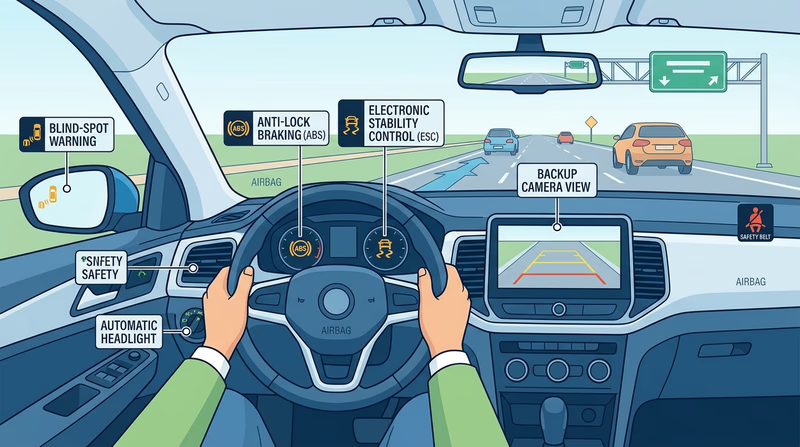
Anti-lock braking system (ABS) — ABS keeps the wheels from locking during hard braking. That helps the driver keep steering control while slowing down.
Electronic stability control (ESC) — Sensors notice when the vehicle is not going where the driver intends, such as during a skid. The system can apply brakes to specific wheels and reduce power to help the vehicle stay under control.
Backup camera — A camera view behind the vehicle helps the driver notice children, pets, bicycles, or low objects that may be hard to see through mirrors alone.
Blind-spot warning — Sensors watch areas beside and slightly behind the car and alert the driver when another vehicle is there.
Daytime running lights or automatic headlights — These make the vehicle easier for others to see and help reduce the chance of an unnoticed approach.
You could also talk about lane-departure warnings, traction control, crumple zones, collapsible steering columns, tire-pressure monitoring systems, or automatic emergency braking.
How to describe a safety feature
Use this pattern when talking with your counselor- Name it: What is the feature called?
- What problem does it address? Skidding, poor visibility, unseen vehicles, hard braking, and so on
- How does it work? Sensor, warning, stronger structure, or automatic control
- Why does it matter? Prevents a crash, lowers crash severity, or protects occupants
🎬 Video: 10 Car Safety Features That Every Car Must Have (video) — https://youtu.be/D2kM8gEoGYY
The best vehicle safety systems work together. A careful driver, properly worn restraints, and a well-equipped vehicle create layers of protection. Up next, you will check whether a vehicle is actually road-ready before the trip begins.
Req 3 — Maintenance and Emergency Stops
A safe driver still needs a safe vehicle. This requirement is a hands-on inspection page: lights, windows, wipers, tires, emergency tire tools, and stopping-distance awareness. Treat it like a preflight check for a trip. Small problems that seem annoying in the driveway can become dangerous at speed.
Requirement 3a
Lights do two jobs at once: they help you see and they help other people understand what you are about to do. A burned-out signal light or dirty taillight removes information other drivers depend on.
What to check
Walk around the vehicle with an adult and test:
- headlights on low beam and high beam
- front and rear turn signals
- brake lights
- hazard flashers
- reverse lights if practical
Make sure the lenses are not caked with mud, snow, or road salt. Then sit in the driver’s seat and identify the switches so you know how to use them quickly.
🎬 Video: Types of Car Lights & Their Purposes (video) — https://youtu.be/8FW-7dfAIwQ
Requirement 3b
A driver cannot respond to what they cannot see. Visibility problems include dirt, inside fogging, cracked glass, frost, glare, water film, worn wipers, and clutter stacked so high in the back seat that it blocks the rear window.
The smear-and-clear test
Spray washer fluid or water onto the windshield and run the wipers. Good blades should clear the glass smoothly. Bad blades chatter, skip, streak, or leave a greasy film that catches headlights.
Visibility problems to notice
Look through every window, not just the windshield- Front: Bug splatter, glare, frost, streaks, cracks
- Rear: Dirt, fog, cargo blocking the view
- Side windows and mirrors: Rain spots, ice, dirt, poor adjustment
- Weather: Mist, heavy rain, snow spray, road slush
🎬 Video: How to Check Your Wipers (video) — https://youtu.be/MmA6Cbn5vH8
Requirement 3c
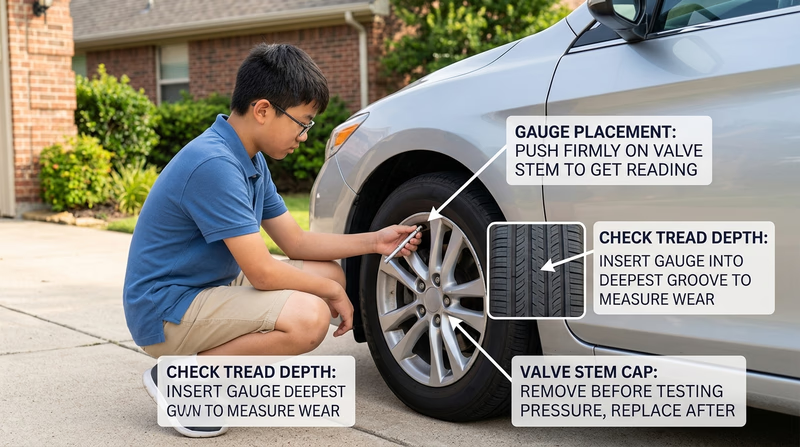
Your tires are the only parts of the vehicle touching the road. All braking, turning, and accelerating depend on those four contact patches. That is why tire condition matters so much.
The recommended tire pressure is usually found on a sticker inside the driver’s door frame, not on the maximum-pressure number molded into the tire sidewall. Use a tire gauge when the tires are cold. For tread, many people use the penny test, but any tread-depth gauge works even better.
Why pressure and tread matter
- Traction: Better grip in turns and during braking
- Stopping distance: Underinflated or worn tires need more distance to stop
- Tire wear: Wrong pressure wears the tread unevenly
- Fuel economy: Underinflated tires create more rolling resistance
🎬 Video: How to Check Your Tires (video) — https://youtu.be/2Tcvmp4Cqao
Requirement 3d
A flat tire feels like a problem you can solve later until it happens in the rain, after dark, or on a shoulder with traffic rushing by. Knowing where the tools are and how they work turns panic into a checklist.
Tools to locate first
Most vehicles that still carry a spare tire also carry:
- a jack
- a lug wrench
- a spare tire or temporary spare
- a place to store or lower the spare
- owner-manual instructions
Some newer vehicles replace the spare with an inflator-and-sealant kit. That can temporarily seal some punctures, but not sidewall damage or major tire failures.
Safe flat-tire habits
Steps to explain in your demonstration
- secure the vehicle on level ground
- set the parking brake and hazards
- place the jack at the correct lift point
- loosen lug nuts before fully lifting if appropriate
- lift the vehicle enough to remove and replace the tire
- tighten lug nuts in a star pattern
- lower the vehicle and retighten
- check the repaired or replacement tire as soon as possible
🎬 Video: Tire Inflator and Sealant Kit (video) — https://youtu.be/X3kjWwCENX4
Requirement 3e
This is one of the best reality checks in the badge. Many people think of stopping as one event, but it has two major parts:
- reaction distance — how far the car travels before the driver even begins braking
- braking distance — how far the car travels after the brakes are applied
At higher speeds, both distances grow, and braking distance grows especially fast. Wet pavement lengthens stopping distance even more because tires have less grip.
What your demonstration should show
Use a safe location away from traffic and the official graphic template or another counselor-approved one. Mark the distances for:
- 25 mph on dry pavement and wet pavement
- 55 mph on dry pavement and wet pavement
- 70 mph on dry pavement and wet pavement
The point is not to memorize a single number. The point is to see how much ground a vehicle covers before it can stop.
Stopping Distance Table and Graphs (PDF) The official distance chart and graph set you can use to mark off emergency-stop distances for the required demonstration. Link: Stopping Distance Table and Graphs (PDF) — https://filestore.scouting.org/filestore/Merit_Badge_ReqandRes/Requirement%20Resources/Traffic%20Safety/Stopping%20Distances%20Table%20and%20Graphs.pdf?_t=1764661254🎬 Video: Thinking, Braking, and Stopping Distances (video) — https://youtu.be/ZLHgYgEAPhY
🎬 Video: Stopping Distance Demonstration (video) — https://youtu.be/3mDp0k8Nfjc?si=Zoy8bAbLADxtlsz3
By this point you have looked at the driver, the vehicle, and the stopping space needed to avoid a crash. Next, you will look at the laws and procedures that shape what drivers must do on public roads.
Req 4 — Traffic Safety and the Law
Traffic safety is not just common sense. It is also law. Rules about right-of-way, required documents, school buses, stops, and post-crash duties exist because people have already been hurt when those rules were missing or ignored. This page connects everyday driving behavior to the legal responsibilities behind it.
Requirement 4a
Drivers and bicyclists both use public roads, which means both must follow rules that keep traffic predictable. Predictable road users are safer road users.
Three common examples include:
- Stop controls and traffic lights: Drivers and bicyclists must stop or yield as the signal requires.
- Right-of-way laws: Both must yield in the correct situations, such as to pedestrians in crosswalks or to traffic already in the intersection.
- Lane-use rules: Drivers must stay in lanes and signal changes; bicyclists often must ride with traffic, not against it, and follow local rules about lane position.
You could also discuss speed-related rules, signaling turns, lighting requirements at night, helmet or equipment laws where applicable, and rules against unsafe passing.
🎬 Video: Bicycle Rules of the Road (video) — https://youtu.be/TAwv_BPBAnc
Requirement 4b
A traffic stop can feel stressful, but the safest approach is simple: make the officer’s job easier and avoid sudden movements that create uncertainty.
Good traffic-stop procedure
During a traffic stop
Stay calm, visible, and cooperative- Pull over safely and promptly: Use your signal and stop where there is room.
- Turn off the engine if appropriate and stay in the vehicle: Keep your hands where they can be seen.
- At night, consider turning on the interior light: It helps the officer see inside the vehicle.
- Wait before reaching for documents: Tell the officer where they are before moving.
- Speak respectfully: Even if you disagree, the roadside is not the place for an argument.
🎬 Video: Traffic Stop Etiquette (video) — https://youtu.be/twTVubwyp4E?si=asTzoxN88uwMYZ1T
Requirement 4c
A crash scene can be confusing, emotional, and dangerous. The first priorities are safety, injuries, and the legal duties that follow.
Basic crash procedure
- stop and stay at the scene unless immediate safety requires moving
- check for injuries and call 911 when needed
- move to a safer location if the vehicles can be moved and local rules allow it
- use hazard flashers and stay alert for traffic
- exchange required information with the other driver
- cooperate with law enforcement and document the scene
Information usually includes names, contact details, insurance information, vehicle descriptions, and the location of the crash. Avoid guessing or arguing about fault at the scene.
🎬 Video: What to Do After a Car Accident (video) — https://youtu.be/ljjGN6xST_A?si=P4u_Sc1h6nF6rsnL
Requirement 4d
The three documents most drivers are expected to have are:
- driver’s license
- vehicle registration
- proof of insurance
These documents show that the driver is authorized to drive, the vehicle is properly registered, and financial responsibility requirements have been met.
Three Documents You Should Always Have in Your Car (website) A simple reminder of the key documents drivers should be ready to show during a stop or after a crash. Link: Three Documents You Should Always Have in Your Car (website) — https://www.thirdcoastautos.com/blog/what-paperwork-should-you-keep-in-your-carTraffic safety is easier when rules are clear, but drivers still need roads that communicate well. Next, you will choose one path: how roads are designed for safety or how signs, signals, and markings guide drivers.
Req 5 — Choose Your Roadway Focus
You must choose exactly one option for this requirement. Both paths teach how roads communicate safety, but they do it in different ways. One focuses on the physical design of the roadway. The other focuses on the visual system drivers read every second.
Your Options
- Req 5a — Safer Roads by Design: Study how intersections, medians, shoulders, and interstate features are built to reduce conflict and give drivers more room to recover from mistakes. You will gain a planner’s view of why some roads feel safer than others.
- Req 5b — Reading Signs, Signals, and Markings: Study how colors, shapes, symbols, lights, and pavement markings send quick messages to drivers. You will gain the ability to decode the road’s visual language faster and more accurately.
How to Choose
Choosing Your Option
Think about how you like to learn- If you like engineering and maps: Option 5a may fit you best because it looks at how roads are physically designed.
- If you notice signs and symbols quickly: Option 5b may fit you best because it is about visual communication on the road.
- Time and location: Option 5a is great if you can observe real road layouts in your area; Option 5b works well almost anywhere because signs and markings are everywhere.
- What you will gain: Option 5a builds systems thinking about safer road design; Option 5b strengthens instant recognition and interpretation skills for everyday travel.
Both options point to the same big idea: safer roads depend on clear information. Start with the first option page, then decide whether it is the path you want to discuss with your counselor.
Req 5a — Safer Roads by Design
A safer road is not an accident. Engineers shape roads so drivers get clearer information, fewer surprise conflicts, and more space to recover from mistakes. This requirement asks you to look at common road features and explain how each one reduces risk.
Intersections
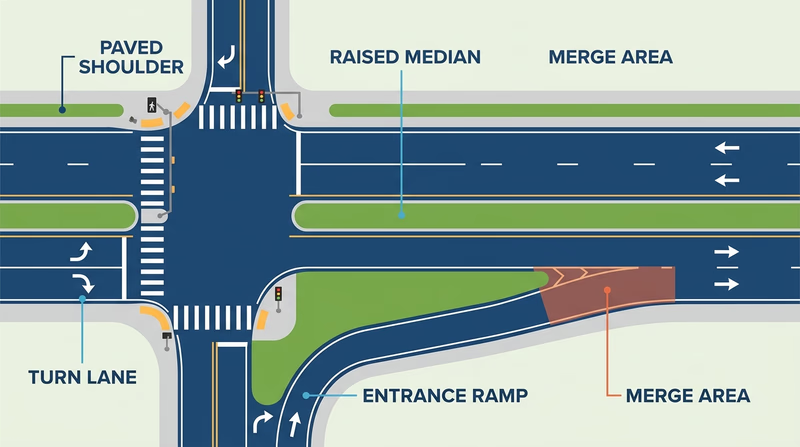
Intersections are conflict points because vehicles, bicycles, and pedestrians may all want the same space at the same time. Good intersection design improves visibility and helps road users understand who moves first.
Examples include turn lanes, traffic signals, stop controls, roundabouts, marked crosswalks, and protected left-turn phases. The goal is to organize movement so drivers have fewer sudden decisions to make.
Medians
Medians separate opposite directions of travel. That reduces the chance of head-on crashes and gives turning vehicles a refuge space on some roads. A raised median can also discourage unsafe passing or random midblock turns.
Road shoulders
Shoulders provide recovery space. If a driver drifts out of the lane, a shoulder may give them room to correct without instantly hitting a ditch, guardrail, or another vehicle. Shoulders also provide space for disabled vehicles, emergency stops, bicyclists in some areas, and maintenance work.
Interstate safety features
Interstates are designed for higher speeds, so they need strong safety features.
- Limited access reduces cross traffic and surprise intersections.
- Entrance and exit ramps manage merging more gradually.
- Wide lanes and shoulders give drivers more recovery space.
- Clear signage warns drivers early about exits, speed changes, and lane use.
- Guardrails and barriers help prevent vehicles from leaving the roadway or crossing into opposing lanes.
- Rumble strips warn drifting drivers with vibration and sound.
🎬 Video: How Highways Are Designed and Built (video) — https://youtu.be/SdYilULmeAc
In the other option, you will study the messages roads send through signs, signals, and markings. Whether you choose this path or not, remember the big lesson: good design helps ordinary people make safer decisions.
Req 5b — Reading Signs, Signals, and Markings
Drivers do not have time to read long explanations at 45 or 65 miles per hour. That is why road communication uses color, shape, symbols, and line patterns that can be recognized almost instantly. A good driver reads this visual language without hesitation.
Why color and shape matter
Colors and shapes act like shortcuts for the brain.
- Red usually means stop, prohibition, or wrong way
- Yellow warns of caution or a changing road condition
- Orange signals work zones and temporary hazards
- Green gives direction information
- Blue often points to services
- Brown usually marks parks or recreation sites
Shapes matter too. For example, an octagon means stop, a triangle points to yield, and a diamond means warning. A driver can often recognize the sign’s purpose before reading any words at all.
Types of traffic control devices
Regulatory signs tell road users what they must or must not do. Speed limits, stop signs, no-turn signs, and one-way signs fit here.
Warning signs alert drivers to something ahead, such as curves, merging traffic, deer crossings, or slippery roads.
Guide signs provide directions, routes, exits, and destination information.
Traffic signals control who moves and who waits at intersections, crosswalks, and some ramps.
Pavement markings organize lanes and show boundaries, turns, no-passing zones, stop lines, and crosswalks.
Pavement markings to notice
- Solid center lines often mean no passing or extra caution
- Broken lines usually mean lane changes or passing are allowed when safe
- Edge lines help define the roadway at night and in poor weather
- Arrows show permitted turn directions
- Crosswalk markings show where drivers should expect pedestrians
🎬 Video: Understanding Road Signs (video) — https://youtu.be/KxrfkcDAgsY
🎬 Video: Traffic Signals (video) — https://youtu.be/Hj87mH_a4jk
🎬 Video: Pavement Markings (video) — https://youtu.be/Lq3p5i9g9c0
How to explain a sign or marking
Use this structure when discussing examples with your counselor- What does it look like? Name the color and shape.
- What category is it? Regulatory, warning, guide, signal, or marking.
- What action does it expect? Stop, yield, slow, merge, stay in lane, or prepare to turn.
- Why is it useful? It gives the driver less to guess about.
The next requirement moves from reading the road to sharing it with people who may be harder to see and easier to hurt: bicyclists, pedestrians, schoolchildren, and drivers around large vehicles.
Req 6 — Sharing the Road Safely
Most serious road conflicts happen because one person forgets that somebody else is there. This requirement shifts your attention outward: to cyclists and pedestrians at night, people walking near roads, children around school buses, and drivers hidden in blind spots. Good traffic safety means noticing the most vulnerable road users before they are in danger.
Requirement 6a
At night, visibility can mean the difference between “I saw them in time” and “I never saw them at all.” A bicycle with lights and reflectors, or a pedestrian wearing reflective material, gives drivers earlier warning. A dark bicycle or person in dark clothing may blend into the background until they are dangerously close.
Reflective material works by bouncing light back toward its source, which makes a person or bicycle stand out in headlights. Proper bike lighting also helps drivers judge where the rider is and which direction they are moving.
🎬 Video: Bike Safety - Sharing the Road (video) — https://youtu.be/zm_uXZJnCSk
🎬 Video: The Basics of Bicycle Safety (video) — https://youtu.be/DJc18FiARLc?si=tV7T0fXYYDHGVdmm
🎬 Video: What to Do to Make Driving at Night Safer (video) — https://youtu.be/uYhwXwVDlF0?si=3M13qEkL7YbemovD
Requirement 6b
Pedestrian safety is about visibility, predictability, and choosing the safest place to move. Four strong measures to discuss are:
- use sidewalks when available
- cross at marked crosswalks or intersections when possible
- look left, right, and left again before crossing
- wear bright or reflective clothing when visibility is poor
Hikers may also need to walk facing traffic when there is no sidewalk, stay single file when needed, and step well clear when vehicles approach.
🎬 Video: The Basics of Pedestrian Safety (video) — https://youtu.be/Lsv1TSy8JbA?si=Yv-ODDQIlOvnSNbC
Requirement 6c
School bus stops are high-risk places because children can be small, hard to see, and unpredictable in movement. Drivers must be extra cautious, not just legally but morally.
Four key measures include:
- stop when the law requires it for a bus with stop arm and flashing signals
- never pass a stopped school bus illegally
- watch carefully for children crossing in front of or behind the bus
- stay stopped until the signals stop and the path is clearly safe
Different states have specific rules about divided and undivided roads, so learn your local law too.
🎬 Video: Driving Safety 101: School Bus Safety (video) — https://youtu.be/XSYE2z3LCUI
Requirement 6d
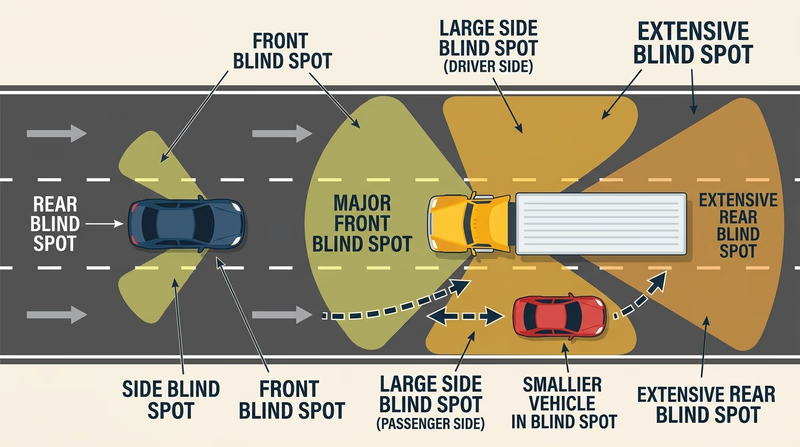
Mirrors do not show everything. Blind spots are areas beside or behind a vehicle that a driver cannot see clearly in the mirrors alone. Trucks have especially large blind spots, but passenger cars have them too.
Why blind spots cause crashes
A driver may signal, glance only at the mirror, and start moving into a lane where another vehicle is hidden. That is why lane changes require more than one quick look.
How to prevent lane-change crashes
Safe lane-change routine
Make each step deliberate- Check mirrors early: Know what traffic is doing behind and beside you.
- Signal before moving: Give others time to react.
- Check your blind spot: Turn your head briefly to confirm the lane is clear.
- Move smoothly, not suddenly: Avoid sharp swerves.
- Do not linger beside large trucks: If you cannot see the truck driver’s mirrors, the driver may not see you.
🎬 Video: Blind Spots Lessons (video) — https://youtu.be/bkX_NSCM0Hw
🎬 Video: Lane Changes (video) — https://youtu.be/H0EA2RD-w2c
Traffic safety is personal, but it is also community work. In the next requirement, you will choose how to engage your community directly: interview a professional, write a pledge, or organize an event.
Req 7 — Choose Your Community Impact
You must choose exactly one option. This requirement is where the badge moves beyond observation and into community action. Each option helps you connect traffic safety to real people, real local problems, and real decisions.
Your Options
- Req 7a — Interview a Safety Professional: Talk with a law enforcement officer or safety professional about the three traffic problems they worry about most. You will gain insight into what traffic safety looks like from the perspective of someone who deals with it every day.
- Req 7b — Write Your Traffic Safety Pledge: Identify your own biggest traffic-safety concerns and turn them into a personal commitment. You will gain self-awareness and a plan for changing your own habits.
- Req 7c — Organize a Safety Event: Plan an activity that teaches others why traffic safety matters. You will gain leadership practice and experience turning safety knowledge into action.
How to Choose
Choosing Your Option
Pick the path that fits your interests and opportunities- Want a real-world expert perspective? Choose 7a.
- Want to examine your own habits honestly? Choose 7b.
- Want to lead and teach others? Choose 7c.
- What you will gain: 7a builds interview and problem-solving skills, 7b builds reflection and accountability, and 7c builds planning and communication.
Pick the option that will help you say something honest and useful to your counselor, not just the one that looks easiest on paper.
Req 7a — Interview a Safety Professional
This option helps you move from guessing about traffic problems to hearing from someone who sees them up close. A school resource officer, police officer, traffic engineer, crossing-safety coordinator, or highway-safety educator can tell you what causes the most trouble in your area and why.
Good interview questions
Start with open-ended questions so the person can explain what they really see:
- What three traffic safety problems concern you most in this community?
- Who is most affected by those problems?
- When and where do they happen most often?
- What causes them to keep happening?
- What would help reduce one of those problems?
How to prepare
Research your community first. Notice school zones, busy intersections, speeding complaints, poor lighting, distracted walking, or risky pickup lines. Then compare your observations with what the professional says.
What to bring to the interview
Keep your notes useful for your counselor discussion- A notebook or question list
- A short introduction explaining why you are doing the interview
- A way to record exact problem areas such as locations, times, or patterns
- A follow-up question about solutions so you are ready for the counselor discussion
🎬 Video: Engineering and Inspector Careers (video) — https://youtu.be/l39mAUI868w?si=zf_CZPPFbjbUstOW
🎬 Video: Women in Road Safety Careers (video) — https://youtu.be/5UQaWsVS4Ww?si=-wXVuWGizEMaz7dZ
Whether you choose this option or another one, the next pages keep showing different ways traffic safety becomes personal and practical.
Req 7b — Write Your Traffic Safety Pledge
A pledge matters only if it is honest. This is not about writing a perfect-sounding paragraph. It is about identifying three traffic-safety issues that genuinely concern you and turning them into clear promises you can keep.
Good topics might include distracted driving, speeding, seat belt use, passenger behavior, school-zone safety, walking at night, bike visibility, or riding with unsafe drivers.
What makes a strong pledge
A strong pledge is:
- personal — it reflects what concerns you
- specific — it names actions, not just values
- practical — it describes habits you can actually follow
- discussable — it gives your counselor something real to talk through with you
A useful structure
Try writing one short paragraph or three bullet promises:
- The issue I care about
- Why it matters to me
- What I will do about it
For example, instead of saying, “I promise to be safe,” say, “I will put my phone where I cannot reach it before any trip because distraction steals attention from the road.” That gives your pledge real meaning.
Take the Pledge (website) A teen-focused pledge example that can help you think about the kinds of habits and commitments worth putting in writing. Link: Take the Pledge (website) — https://www.t-driver.com/pledge/ Parent-Teen Driving Agreement (website) A family driving agreement that shows how specific expectations can turn safety goals into clear promises and shared accountability. Link: Parent-Teen Driving Agreement (website) — https://www.healthychildren.org/English/ages-stages/teen/safety/Pages/teen-driving-agreement.aspxThe last option in this section takes your concern one step further by asking you to organize an event that teaches others why traffic safety matters.
Req 7c — Organize a Safety Event
This option asks you to lead. A good safety event does not have to be huge, but it should help people notice one risk clearly and leave with a better habit than they had before.
Possible events include a troop presentation about distracted driving, a bike-light and reflector demonstration, a school-bus safety reminder campaign, a seat belt awareness table, or a community poster display near a school or library.
Start with one clear message
The strongest events focus on one main point, such as:
- put phones away while driving
- wear seat belts every trip
- make yourself visible at night
- stop properly for school buses
- slow down near schools and crossings
Plan the event like a leader
Safety event planning
Keep your event focused and useful- Pick one audience: troop, school group, families, bicyclists, or neighborhood drivers
- Choose one message: make it easy to remember
- Decide how people will participate: demonstration, poster, talk, quiz, pledge board, or gear check
- Gather materials early: signs, reflectors, handouts, or display items
- Measure success: number of participants, questions asked, pledges signed, or gear checked
🎬 Video: Teen Driving Safety Event (video) — https://youtu.be/v8zcyY194jI?si=St3aTOW9HnAHT7oh
By now you have studied traffic safety from many angles: driver behavior, vehicle readiness, law, road design, and community action. The last requirement asks you to look at the people who build careers around this work every day.
Req 8 — Careers in Traffic Safety
Traffic safety is not one job. It is a whole network of careers that work on human behavior, road design, vehicle systems, law enforcement, emergency response, data analysis, and public education. If this badge made you wonder who decides where crosswalks go, who studies crash patterns, or who keeps work zones safe, this requirement is where you start exploring.
Careers you might research
Here are a few strong examples:
- Traffic engineer — designs intersections, signal timing, lane layouts, and safer road features
- Traffic signal technician — installs, tests, and repairs signal systems
- Highway safety specialist — studies crash data and recommends improvements
- Law enforcement officer — enforces traffic laws and responds to crashes
- Transportation planner — helps communities design safer systems for cars, bikes, and pedestrians
- Work-zone traffic control specialist — keeps drivers and road crews safe around construction
What to find out about one career
When you research, organize your notes under the exact topics the requirement asks for:
- training and education needed
- cost of that education or training
- job prospects
- salary range
- day-to-day duties
- chances for advancement
Research organizer
Bring this structure to your counselor discussion- Career name and what it does
- How someone gets started
- What training costs
- Where jobs are found
- What a normal workday looks like
- Why the career might interest you
🎬 Video: What It's Like to Work in Traffic Control and Safety in Road Construction (video) — https://youtu.be/RA5GljWCPhQ?si=tzgUiIj2PWhx2-j3
🎬 Video: On The Job: Traffic Signal Technician (video) — https://youtu.be/qcLQd4eTj8A?si=aQ2EYV2mPDoWlf1Q
You have now completed the main learning path of the guide. Next comes Extended Learning, where you can keep going beyond the badge into real-world systems, safer-street ideas, and future opportunities.
Extended Learning
Congratulations
You have finished a badge that asks you to think like a driver, a passenger, a pedestrian, a planner, and a community member all at once. That matters because traffic safety is not a one-time lesson. It is a lifelong habit of noticing risk early, making careful choices, and protecting other people as seriously as you protect yourself.
Safer Systems, Not Just Safer People
A lot of traffic-safety advice focuses on individual behavior, and that matters. But modern safety work also asks how roads, vehicles, and public rules can reduce harm even when people make mistakes. Engineers call this a systems approach.
For example, a safer intersection might use better lighting, clearer lane markings, shorter crossing distances, and signal timing that gives pedestrians more protection. None of those features replaces personal responsibility, but together they make serious injury less likely.
This way of thinking can change how you notice your community. Instead of saying, “People drive badly here,” you may start asking, “What about this place makes confusion more likely?”
Why Speed Changes Everything
Speed does more than get a vehicle somewhere faster. It changes how far the vehicle travels before stopping, how much force a crash produces, and how much time everyone else has to react. A small increase in speed can create a much larger increase in danger.
That is one reason school zones, neighborhood streets, and work zones matter so much. In places where people are close to traffic, lower speeds give drivers more time and make crashes less severe.
Designing for People Outside the Car
Many roads were built mainly for vehicle movement, but communities today are rethinking that. Sidewalks, bike lanes, refuge islands, traffic-calming designs, better bus stops, and safer crossings help people who are walking, biking, rolling, or waiting near traffic.
A strong traffic-safety mindset includes empathy. The road may feel very different depending on whether you are behind a windshield or standing on the edge of the curb with traffic rushing by.
Real-World Experiences
Observe a Busy Intersection
Visit a Transportation or Public Works Office
Attend a Community Safety Meeting
Do a Night Visibility Check
Organizations
Federal agency focused on reducing deaths and injuries from crashes through research, education, standards, and public safety campaigns.
Organization: National Highway Traffic Safety Administration — https://www.nhtsa.gov/
National organization connecting state highway safety offices and sharing information about major traffic-safety trends and solutions.
Organization: Governors Highway Safety Association — https://www.ghsa.org/
Nonprofit focused on preventing childhood injuries, including pedestrian safety, teen driving, and child passenger protection.
Organization: Safe Kids Worldwide — https://www.safekids.org/
Professional organization for people who design and manage transportation systems, including signals, roads, and safer street networks.
Organization: Institute of Transportation Engineers — https://www.ite.org/