Req 6 — Sharing the Road Safely
Most serious road conflicts happen because one person forgets that somebody else is there. This requirement shifts your attention outward: to cyclists and pedestrians at night, people walking near roads, children around school buses, and drivers hidden in blind spots. Good traffic safety means noticing the most vulnerable road users before they are in danger.
Requirement 6a
At night, visibility can mean the difference between “I saw them in time” and “I never saw them at all.” A bicycle with lights and reflectors, or a pedestrian wearing reflective material, gives drivers earlier warning. A dark bicycle or person in dark clothing may blend into the background until they are dangerously close.
Reflective material works by bouncing light back toward its source, which makes a person or bicycle stand out in headlights. Proper bike lighting also helps drivers judge where the rider is and which direction they are moving.
🎬 Video: Bike Safety - Sharing the Road (video) — https://youtu.be/zm_uXZJnCSk
🎬 Video: The Basics of Bicycle Safety (video) — https://youtu.be/DJc18FiARLc?si=tV7T0fXYYDHGVdmm
🎬 Video: What to Do to Make Driving at Night Safer (video) — https://youtu.be/uYhwXwVDlF0?si=3M13qEkL7YbemovD
Requirement 6b
Pedestrian safety is about visibility, predictability, and choosing the safest place to move. Four strong measures to discuss are:
- use sidewalks when available
- cross at marked crosswalks or intersections when possible
- look left, right, and left again before crossing
- wear bright or reflective clothing when visibility is poor
Hikers may also need to walk facing traffic when there is no sidewalk, stay single file when needed, and step well clear when vehicles approach.
🎬 Video: The Basics of Pedestrian Safety (video) — https://youtu.be/Lsv1TSy8JbA?si=Yv-ODDQIlOvnSNbC
Requirement 6c
School bus stops are high-risk places because children can be small, hard to see, and unpredictable in movement. Drivers must be extra cautious, not just legally but morally.
Four key measures include:
- stop when the law requires it for a bus with stop arm and flashing signals
- never pass a stopped school bus illegally
- watch carefully for children crossing in front of or behind the bus
- stay stopped until the signals stop and the path is clearly safe
Different states have specific rules about divided and undivided roads, so learn your local law too.
🎬 Video: Driving Safety 101: School Bus Safety (video) — https://youtu.be/XSYE2z3LCUI
Requirement 6d
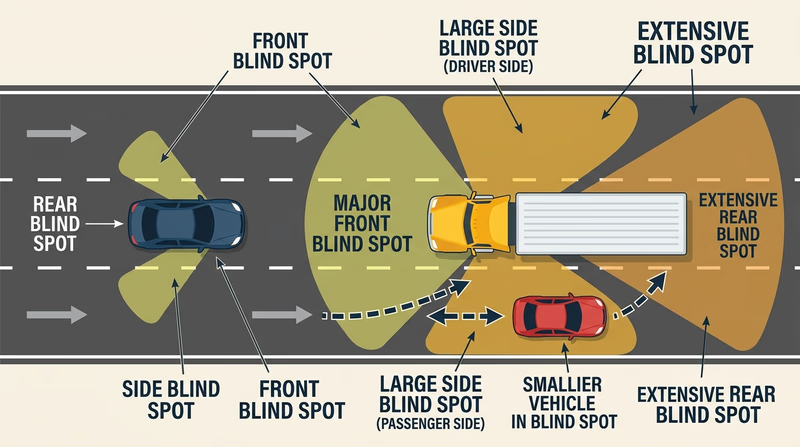
Mirrors do not show everything. Blind spots are areas beside or behind a vehicle that a driver cannot see clearly in the mirrors alone. Trucks have especially large blind spots, but passenger cars have them too.
Why blind spots cause crashes
A driver may signal, glance only at the mirror, and start moving into a lane where another vehicle is hidden. That is why lane changes require more than one quick look.
How to prevent lane-change crashes
Safe lane-change routine
Make each step deliberate
- Check mirrors early: Know what traffic is doing behind and beside you.
- Signal before moving: Give others time to react.
- Check your blind spot: Turn your head briefly to confirm the lane is clear.
- Move smoothly, not suddenly: Avoid sharp swerves.
- Do not linger beside large trucks: If you cannot see the truck driver’s mirrors, the driver may not see you.
🎬 Video: Blind Spots Lessons (video) — https://youtu.be/bkX_NSCM0Hw
🎬 Video: Lane Changes (video) — https://youtu.be/H0EA2RD-w2c
Traffic safety is personal, but it is also community work. In the next requirement, you will choose how to engage your community directly: interview a professional, write a pledge, or organize an event.