Req 5 — Starts, Wakes, and Falls
This requirement is the heart of the badge’s action skills. You are showing that you can start under control, move across the wake with balance, and handle an unexpected stop without turning it into a dangerous crash.
Requirement 5a
A deepwater start often decides how confident the rest of the run will feel. If you rush, fight the boat, or stand too early, the start becomes harder than it needs to be. If you stay compact and let the boat do the work, the start becomes much smoother.
Entering the water from the boat
Use the stern platform or ladder when boarding and entering. Keep clear of the propeller area, and never approach the stern while the motor is running. Enter with your gear in an organized way so the rope, handle, skis, or board do not tangle around you.
Deepwater start basics
- float in a balanced crouch
- keep the handle low and close
- point skis or board in the right starting position
- let the boat pull you up instead of trying to jump to your feet
- keep arms straight and knees bent as you rise
For two skis, keep the tips up and close together. For a wakeboard, keep the board sideways until the pull begins, then let the board rotate under you. In both cases, patience matters more than strength.
Deepwater start sequence
Think smooth, not sudden
- Get set: Body compact, knees bent, handle in close, eyes up.
- Wait for tension: Do not call for speed until the rope is tight.
- Let the boat pull: Resist the urge to stand up too fast.
- Rise gradually: Move from crouch to balanced riding stance.
- Settle before steering: Get stable before trying to turn or edge.
Requirement 5b
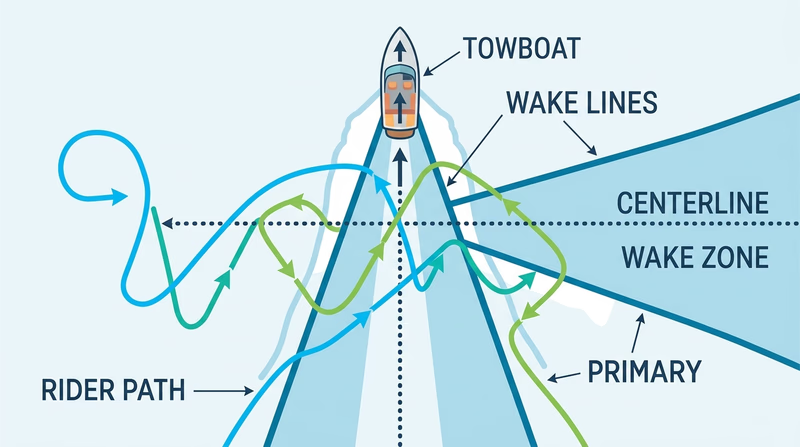
Wake crossing tests control, not bravado. The goal is to edge smoothly out, cross both wakes, and come back to center without getting bounced off balance.
Approach to wake crossing
Start outside the wakes in a stable stance with knees soft and eyes ahead. As you move in, hold a steady edge instead of making sudden jerks on the handle. Let your legs absorb the wake bumps while your upper body stays quiet.
What helps you stay in control
- a low, relaxed center of gravity
- handle close to your hips instead of high and far away
- steady pressure through both feet
- looking where you want to go, not down at the water
- patience returning to center before starting the next crossing
Returning to the center each time
The requirement is not only about crossing out and back. It is about returning to the center wake under control after each pass. That proves you are riding the whole pattern, not barely surviving one edge change.
Requirement 5c
Good riders do not just know how to stay up. They know how to stop a problem before it becomes a worse crash. Sometimes the safest move is to let go, fall away from danger, and protect your body.
Falling properly
If an obstacle, unsafe line, or loss of control makes continuing a bad idea, release the handle and fall in a controlled way. Do not try to save every run. A planned fall is much safer than hanging on too long.
In general, you want to:
- let go early rather than late
- avoid twisting against the pull of the rope
- fall away from the obstacle if possible
- keep arms and legs from reaching wildly for the water
- stay calm once you surface and signal your condition
Dropping the handle and coasting to a stop
This skill shows that you can end the pull smoothly instead of collapsing the second tension disappears. When you release the handle, stay balanced over your feet or board, keep knees bent, and ride the glide until you slow naturally.
These three parts fit together: controlled starts, controlled movement, and controlled exits. The final requirement keeps that same idea focused on your gear — fitting it correctly and handling it after a fall.