Req 10a — Build an Instrument and Keep a Log
This option turns you into a weather observer. Instead of only reading forecasts, you will build a simple tool, collect data at the same time each day, and compare predictions with what the sky actually did. That is exactly the kind of habit that helps meteorologists spot patterns.
Choose your instrument
Each instrument teaches you something different.
Wind vane
A wind vane shows wind direction. It is best if you want to focus on how air moves around your home or campsite.
Anemometer
An anemometer measures wind speed. It is helpful if you want to compare calm and breezy days more carefully.
Rain gauge
A rain gauge measures precipitation. It is simple, practical, and especially useful if showers are common where you live.
Hygrometer
A hygrometer measures humidity. This is great if you want to compare muggy and dry conditions or connect moisture to dew, frost, and comfort.
🎬 Video: Weather 101: Build Your Own Wind Vane! (video) — https://youtu.be/kSHRBUTMq0o?si=6XqGX8yB-svIK85z
🎬 Video: DIY Anemometer (Measure Wind Speed) (video) — https://youtu.be/Gab07UaoeZI?si=iQpXL42eMjDoNIkz
🎬 Video: How to Make a Rain Gauge (video) — https://youtu.be/MLmVaiSEF9w?si=atHOcyY2Yfn2Vu-W
🎬 Video: How to Make Your Own Hygrometer (video) — https://youtu.be/lNPSzifZ-Y0?si=4_dPuJHkkLw5hp75
Set up your observation routine
The Weather merit badge pamphlet recommends keeping a weather log and making entries at the same time each day. That matters because weather changes all day long. If you check at 7 a.m. one day and 5 p.m. the next, your comparison becomes much less useful.
Try to choose a time you can actually keep for seven straight days.
Record:
- wind direction and speed
- temperature
- precipitation
- cloud types
- morning dew or frost when present
- forecast from radio or television
- what weather really happened later
Good weather log habits
Small choices make your data much better
- Use the same time every day: Consistency matters more than the exact hour.
- Use the same location: That reduces extra variables.
- Write observations right away: Do not trust your memory later.
- Compare prediction to reality: The forecast is part of the assignment, not just your measurement.
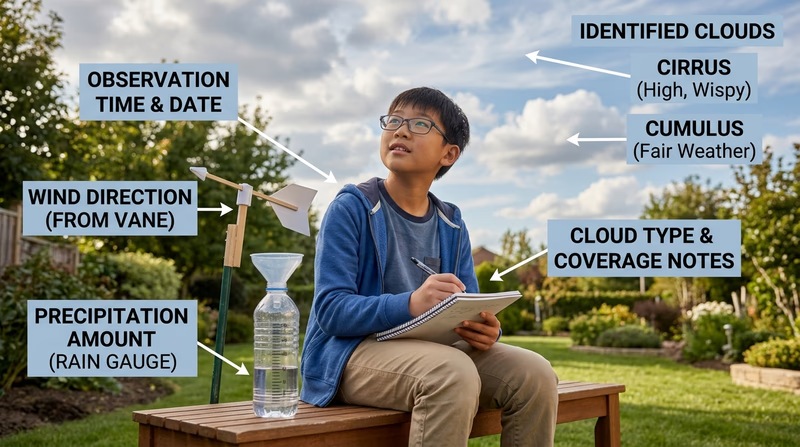
What makes a strong log?
A strong log is readable and specific. Do not just write “nice weather” or “bad weather.” Use real terms like:
- scattered cumulus
- steady light rain
- wind from the northwest
- frost on grass at sunrise
- forecast called for storms after 3 p.m.; actual storm arrived at 5 p.m.
That kind of detail helps you and your counselor see whether you observed carefully.
Compare forecasts honestly
Forecasts are not magic. They are informed predictions. Sometimes they are close. Sometimes the timing is off or your exact location experiences something slightly different.
That is not a failure. It is part of what makes this option valuable. You are learning that weather depends on location, timing, and changing conditions.
Connect it to other requirements
This option brings together much of what you already studied:
- Req 3 helps you choose forecast sources.
- Req 4 helps you notice fronts and pressure changes.
- Req 6 helps you identify cloud types.
- Req 7 helps you understand moisture, dew, frost, and precipitation.
That is why this requirement is such a good test of whether the badge concepts are starting to fit together.
The next option takes a different path. Instead of building and logging, you will learn directly from a weather expert or office about local dangers and warning systems.