Req 7 — The Water Cycle in Motion
The water cycle is one of the most important ideas in weather because it explains where clouds and precipitation come from. The air does not make water out of nothing. It moves water already on Earth from oceans, lakes, soil, plants, clouds, rivers, ice, and groundwater through a repeating cycle.
The major processes to include
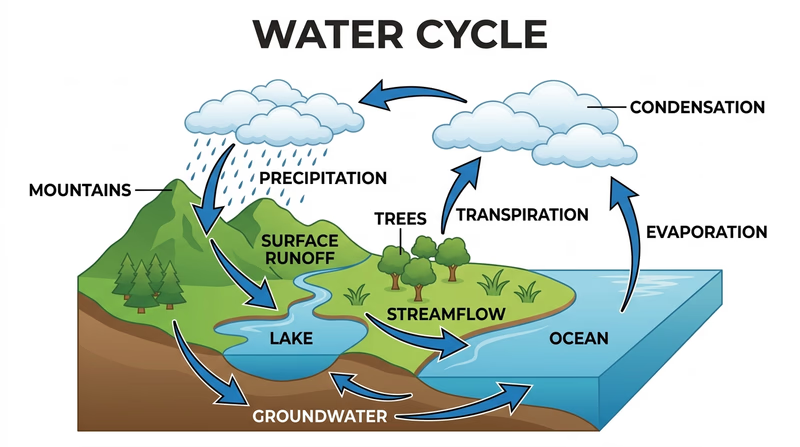
The Weather merit badge pamphlet highlights these major parts of the cycle: evaporation, transpiration, condensation, precipitation, runoff, streamflow, and groundwater movement. Those are the labels you should be ready to place on your diagram and explain out loud.
Evaporation
Evaporation happens when liquid water changes into water vapor and rises into the air. Oceans provide most of the water vapor in the atmosphere, but lakes, streams, and wet ground also add moisture.
Transpiration
Transpiration is water released by plants, mainly through their leaves. Plants are part of the weather story because they return moisture to the air.
Condensation
Condensation happens when water vapor cools enough to change back into tiny liquid droplets or ice crystals. That process helps form clouds, fog, dew, and frost.
Precipitation
When cloud droplets or ice particles grow large enough, they fall as precipitation. That includes rain, snow, sleet, or hail.
Runoff and streamflow
Water that falls on land may move across the surface into rivulets, streams, rivers, and eventually the ocean. That surface movement is runoff, and the movement through streams and rivers is part of streamflow.
Infiltration and groundwater
Some water soaks into the ground and helps refill underground water supplies. The pamphlet explains that some of this water becomes groundwater and may collect in aquifers.
🎬 Video: How Does Rain Form and What is the Water Cycle? (video) — https://youtu.be/zBnKgwnn7i4?si=VZrtRmGFKtiaNJCV
How to draw a strong diagram
Your diagram does not have to be artistic. It does need to be clear. A strong water cycle diagram includes:
- the sun as the energy source
- a large body of water such as an ocean or lake
- evaporation rising upward
- cloud formation from condensation
- precipitation falling to land and water
- runoff moving over land into streams or rivers
- groundwater soaking downward
- transpiration from plants
Water cycle drawing checklist
Make sure these labels appear on your diagram
- Evaporation from oceans, lakes, or other water surfaces
- Transpiration from plants
- Condensation forming clouds
- Precipitation falling from clouds
- Runoff moving across the land
- Groundwater soaking into or moving under the ground
- Streams or rivers carrying water back toward larger bodies of water
🎬 Video: Easy Water Cycle Drawing (video) — https://youtu.be/l4h_z1Hy-lE?si=WnRWlOT2aHIX5TGI
How to explain it aloud
If your counselor asks you to explain the cycle, talk through it like a trip:
- Water evaporates from oceans, lakes, and wet surfaces.
- Plants add moisture through transpiration.
- Water vapor rises and cools.
- Condensation forms clouds.
- Precipitation falls.
- Water runs off, soaks in, freezes, melts, or flows through streams.
- Eventually much of it returns to larger bodies of water and the cycle continues.
That explanation shows that the water cycle is not a circle drawn on paper only. It is a real, always-moving system.
Why this matters in weather
The water cycle explains why humidity changes, why clouds form, why dew or frost appears, and why different places get different amounts of precipitation. It also connects to Req 5 and Req 6: rain depends on condensation and precipitation, and clouds are visible evidence that the cycle is active overhead.
Next you will step back and look at how human actions can change the environment, the climate, and the way weather affects people.