Req 3 — Tools and Sharpening
This requirement is about control. Before you can carve cleanly, you need to know what each tool is meant to do and how to keep its edge ready for work. A carver who understands tools can work more safely and with much less frustration.
Requirement 3a
You do not need a giant toolkit to carve well, but you do need to know what each tool is for. Here are five common tool types you can discuss confidently with your counselor.
1. Carving knife
The carving knife is the main tool for shaping wood. It is used for paring cuts, basic cuts, stop cuts, and detail work. Keep the blade sharp, clean, and dry. Store it closed or sheathed, and never leave it hidden under shavings on the table.
2. Roughout knife or larger utility knife
A larger knife removes wood faster during the early shaping stage. This tool helps you bring a block down to a simpler form before switching to a smaller blade for detail. Because it removes more wood per stroke, it demands extra attention to cut direction.
3. Gouge
A gouge has a curved cutting edge that scoops or channels wood. It is useful for hollows, rounded details, and some relief carving work. Gouges must be kept sharp and protected so the edge does not bang into other tools.
4. V-tool or veiner
A V-tool makes crisp grooves and lines, especially in relief work and decorative detail. It is excellent for borders, feathers, fur lines, and deep corners that are hard to reach with a straight blade.
5. Mallet or light carving hammer
Some carving tools are designed to be tapped rather than pushed only by hand. A carving mallet gives controlled force to chisels or gouges, especially when removing background in relief carving. Use only the tool and striking method your counselor approves.
How to talk about a carving tool
Use this pattern for any tool you choose
- What it does: What kind of cut or shaping job is it made for?
- When to use it: Rough shaping, detail work, grooves, smoothing, or background removal?
- How to care for it: Sharpening, cleaning, rust prevention, safe storage.
- What can go wrong: Slipping, chipping the edge, using the wrong amount of force, or cutting in the wrong direction.
Tool care basics
Good tool care is simple: wipe tools clean after use, keep moisture off metal, touch up edges before they get badly dull, and store tools where the cutting edges are protected. A blade tossed loose into a toolbox gets dull faster and is more dangerous the next time someone reaches in.
Requirement 3b
Sharpening is one of the most important carving skills you can learn. A carver with ordinary talent and sharp tools often does better work than a talented carver using dull ones.
Common sharpening devices
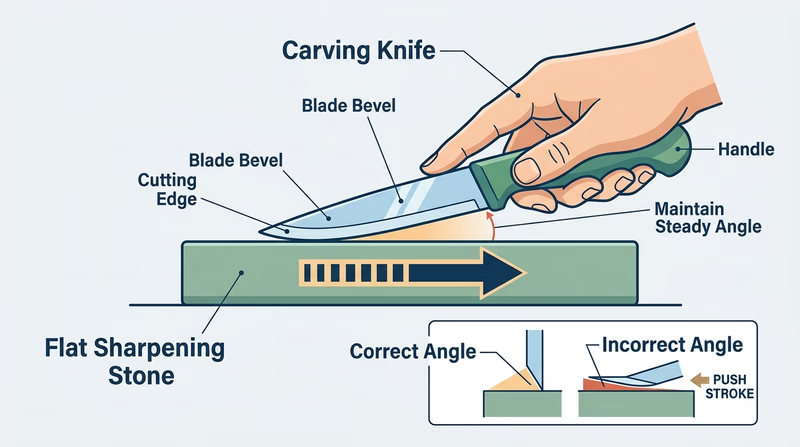
Whetstones or sharpening stones remove metal to rebuild the edge. They may be oil stones, water stones, or diamond stones. Each works a little differently, but all depend on holding a steady angle.
Diamond plates cut quickly and stay flat. They are useful for sharpening and for flattening some other stones.
Slipstones or shaped stones help sharpen curved tools like gouges and V-tools because they fit inside the curve better than a flat stone.
Strops polish the edge after sharpening. A leather strop with honing compound removes the tiny burr and refines the edge so it slices more cleanly.
The idea behind sharpening
Sharpening is not random rubbing. You are shaping two bevels so they meet in a clean edge. The key is consistency: same angle, smooth passes, light pressure, and patience.
In Req 4, you will put these sharp tools to work on the core cuts that appear again and again in carving projects.