Req 2a — From Tree to Lumber
Every piece of lumber in your workshop started as a living tree. Understanding how wood goes from forest to workbench helps you choose the right materials and appreciate the natural resource you are working with.
How Timber Is Grown
Trees used for lumber are grown in two main ways:
Natural forests contain a mix of species that grow on their own over decades or centuries. Hardwoods like oak, walnut, and cherry often come from managed natural forests where foresters selectively harvest mature trees while leaving younger ones to grow.
Tree plantations (also called tree farms) grow a single species in rows, much like a crop. Softwoods like pine, spruce, and Douglas fir are commonly plantation-grown because they mature relatively quickly — a pine tree can be ready for harvest in 25 to 30 years, while a hardwood like oak may take 60 to 100 years.
Harvesting Timber
When trees reach maturity, professional loggers harvest them using several methods:
- Selective cutting removes only mature or specific trees, leaving the rest of the forest intact. This is common for high-value hardwoods.
- Clear-cutting removes all trees in a defined area. It is used for plantation-grown softwoods and is followed by replanting.
- Shelterwood cutting removes trees in stages over several years, allowing natural seedlings to grow under the shelter of remaining trees.
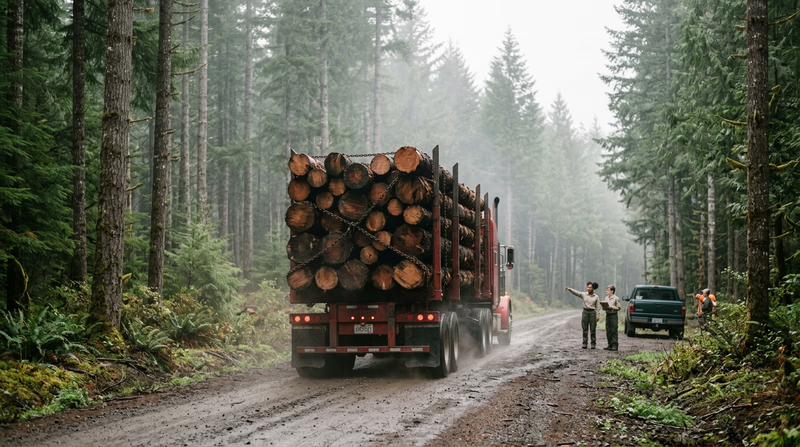
After felling, logs are “bucked” (cut to manageable lengths), loaded onto trucks, and transported to a sawmill.
Milling Lumber
At the sawmill, logs are transformed into usable lumber through a series of steps:
- Debarking — The bark is stripped off using rotating blades or high-pressure water.
- Primary breakdown — A large bandsaw or circular saw cuts the log into thick slabs called “cants.”
- Resawing — Cants are cut into boards of standard thicknesses.
- Edging — Rough, irregular edges are trimmed to create straight-sided boards.
- Trimming — Boards are cut to standard lengths.
The sawyer (the person operating the main saw) makes critical decisions about how to cut each log to maximize the amount of usable lumber and minimize waste.
Plain-Sawn vs. Quarter-Sawn
The angle at which a log is cut affects the appearance, strength, and stability of the resulting boards:
- Plain-sawn (also called flat-sawn) is the most common and economical method. The log is cut in parallel slices, producing boards with cathedral-shaped grain patterns. These boards are more likely to warp and cup as they dry.
- Quarter-sawn cuts the log into quarters first, then slices each quarter perpendicular to the growth rings. This produces straight, parallel grain lines and boards that are more stable and resistant to warping — but more expensive because the process wastes more wood.
Curing and Seasoning Lumber
Freshly cut wood (called “green” wood) contains a large amount of water — sometimes more than half its weight. Before it can be used in woodworking, this moisture must be removed through a process called seasoning or curing.
Air Drying
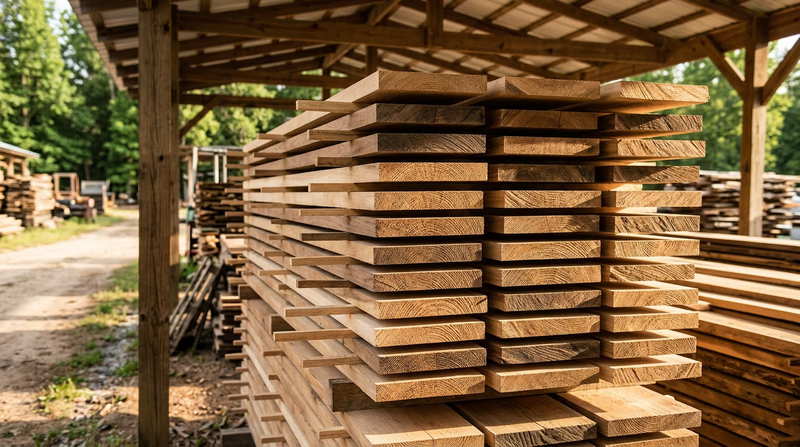
Boards are stacked outdoors with spacers (called “stickers”) between each layer to allow air to circulate. Air drying is slow — it can take one year per inch of board thickness — but it is gentle on the wood and produces excellent results.
Kiln Drying
Lumber is placed inside a large oven (a kiln) where temperature and humidity are carefully controlled. Kiln drying takes days to weeks instead of months to years. Most commercially available lumber is kiln-dried.
The target moisture content for indoor furniture and cabinetwork is typically 6 to 8 percent. For outdoor projects, 12 to 15 percent is acceptable.
Grading Lumber
Lumber is graded by quality. Hardwood and softwood use different grading systems.
Hardwood Grades (National Hardwood Lumber Association)
| Grade | Description |
|---|---|
| FAS (First and Seconds) | Highest quality. Long, wide boards with very few defects. |
| Select | One good face, minor defects on the back. |
| #1 Common | Shorter clear sections. Good for smaller projects. |
| #2 Common | More knots and defects. Suitable for rustic projects. |
Softwood Grades
Softwood is typically graded as Select (A through D, with A being nearly perfect) or Common (#1 through #5, with #1 being the best).
Sizing Lumber
Lumber sizes are expressed in nominal dimensions, which are the rough-cut size before the wood is planed smooth. The actual size is smaller:
| Nominal Size | Actual Size |
|---|---|
| 1 × 4 | ¾" × 3½" |
| 1 × 6 | ¾" × 5½" |
| 2 × 4 | 1½" × 3½" |
| 2 × 6 | 1½" × 5½" |
| 4 × 4 | 3½" × 3½" |
Hardwood lumber is sold by thickness in quarter-inch increments: 4/4 (four-quarter, meaning 1 inch rough), 5/4 (1¼ inch), 6/4 (1½ inch), 8/4 (2 inches), and so on. After planing, a 4/4 board ends up about 13/16 inch thick.
U.S. Forest Service — Forest Inventory and Analysis Data and reports on the status and trends of American forests, including timber growth and harvest statistics.