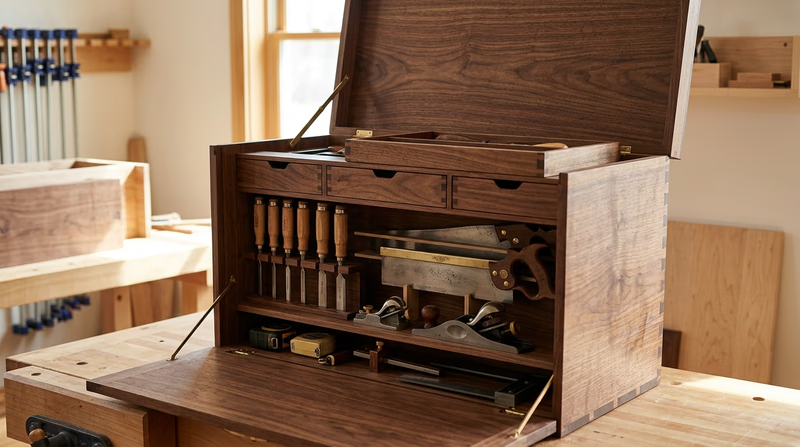
Req 3a — Tool Care & Storage
Good tools, properly maintained, can last a lifetime — or even multiple lifetimes. Many woodworkers use hand planes and chisels that are 50 to 100 years old. The key is knowing how to care for them, use them correctly, and store them so they stay sharp and rust-free.
Essential Hand Tools
Here are the core hand tools you will use for this merit badge and how to care for each one.
Hand Saws
Types you may use: crosscut saw, rip saw, coping saw, back saw, dovetail saw
Proper use:
- Match the saw to the task — crosscut saws cut across the grain, rip saws cut along the grain.
- Start cuts with a few light pull strokes to establish a groove (called a “kerf”).
- Use the full length of the blade with long, smooth strokes.
- Let the saw do the work — do not force it.
Care and storage:
- Wipe the blade with a light coat of oil (camellia oil or paste wax) after use to prevent rust.
- Hang saws on pegs or in a saw till — never toss them into a toolbox where the teeth can be damaged.
- If teeth become dull, have them professionally sharpened or learn to sharpen them yourself with a saw file.
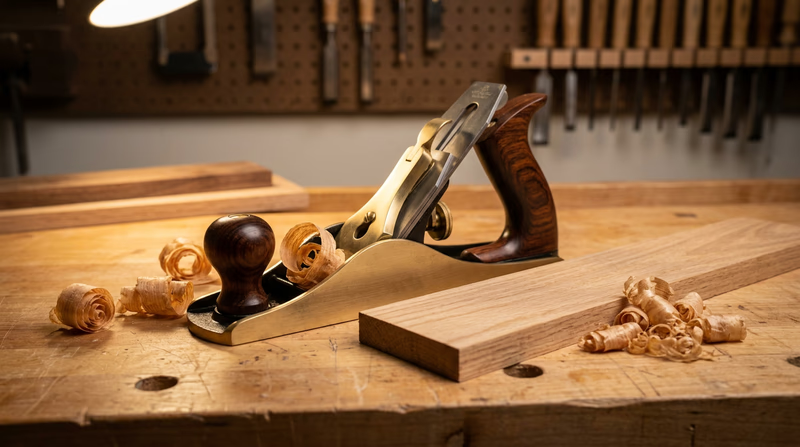
Planes
Types you may use: block plane, jack plane, smoothing plane
Proper use:
- Adjust the blade depth so it takes thin, even shavings — not thick chunks.
- Plane in the direction of the grain (look at the edge of the board to see which way the grain runs).
- Apply even downward pressure with both hands.
Care and storage:
- Retract the blade before setting the plane down.
- Never place a plane sole-down on a metal bench — lay it on its side.
- Wipe the sole and blade with oil to prevent rust.
- Store in a dry location, preferably in a plane till or on a shelf with the blade retracted.
Chisels
Types you may use: bench chisels (¼", ½", ¾", 1")
Proper use:
- Always chisel away from your body.
- Use a mallet (wooden or rubber) to drive the chisel — never a metal hammer, which damages the handle.
- Make light cuts, removing small amounts of material at a time.
- Keep your free hand behind the cutting edge at all times.
Care and storage:
- Protect the cutting edge with blade guards or a chisel roll.
- Wipe blades with oil after use.
- Never use chisels as pry bars, scrapers, or screwdrivers.
Hammers and Mallets
Proper use:
- Grip near the end of the handle for maximum control and power.
- Strike squarely — glancing blows bend nails and can send a hammer head flying.
- Use a nail set to drive finish nails below the wood surface without denting the surrounding area.
Care and storage:
- Check that the head is tight on the handle before every use. A loose head is extremely dangerous.
- Store hanging on a rack or standing upright — never lying on a bench where it can roll off.
Brace and Bit
A brace is a hand-powered drill that uses a cranking motion. Bits are the cutting attachments.
Proper use:
- Secure the workpiece in a vise or with clamps.
- Start slowly to establish the hole, then crank with steady, even pressure.
- When drilling through, place a scrap board underneath to prevent blowout on the exit side.
Care and storage:
- Keep bits in a roll or indexed case — loose bits in a drawer get dull and damaged.
- Oil the chuck mechanism periodically.
- Wipe bits with oil to prevent rust.
Measuring and Marking Tools
Accurate projects start with accurate measurements. These tools do not cut wood, but they are just as important as those that do.
- Tape measure — For rough measurements. Keep the blade clean and the spring mechanism free of sawdust.
- Combination square — For marking 90° and 45° angles and checking surfaces for square. Keep the blade and stock free of debris.
- Marking gauge — For scribing parallel lines along a board’s edge. Keep the pin or blade sharp.
- Pencil — A sharp #2 pencil is one of the most important tools in the shop. Keep several on hand.
General Storage Principles
Tool Storage Best Practices
Keep your tools ready for the next project
- Store tools in a dry environment: Moisture is the enemy — it causes rust on metal and mildew on wooden handles.
- Give every tool a home: Pegboard, tool racks, drawer organizers, or a tool chest. When you know where a tool belongs, you will notice immediately if it is missing.
- Protect cutting edges: Use blade guards, sheaths, or chisel rolls. Cutting edges that bump against each other in a drawer get dull fast.
- Oil metal surfaces: A thin coat of paste wax, camellia oil, or light machine oil prevents rust.
- Keep tools clean: Wipe sawdust, pitch, and glue off tools at the end of each session.